
 ZeckRV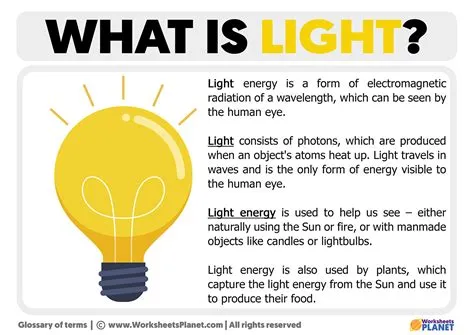
INTERIORDECOR.BIZ.ID – Light is a fundamental concept in physics, essential for our perception of the world and countless natural processes. Its definition encompasses electromagnetic radiation that is visible to the human eye.
Broadly defined, light is a form of electromagnetic energy that travels in waves, a concept rooted in our understanding of physics. This wave-like nature allows it to propagate through vacuum and various media, carrying energy and information.
The Nature of Light
In essence, light is part of the electromagnetic spectrum, which includes radio waves, microwaves, infrared, visible light, ultraviolet, X-rays, and gamma rays. Our eyes are sensitive to a narrow band within this spectrum, which we perceive as colors.
The energy carried by light is quantized into packets of energy called photons, a concept introduced by quantum mechanics. These photons behave as both waves and particles, exhibiting wave-particle duality.
Key Properties of Light
One of the most defining characteristics of light is its speed; it travels at approximately 299,792 kilometers per second in a vacuum, the fastest speed possible in the universe.
Light also exhibits reflection and refraction when it encounters different surfaces or media. Reflection is the bouncing back of light, while refraction is the bending of light as it passes from one medium to another.
Interaction with Matter
When light interacts with matter, several phenomena can occur, including absorption, scattering, and transmission. Absorption happens when matter takes in the energy of light, often converting it into heat.
Scattering occurs when light deviates from its straight path due to interaction with particles in a medium, explaining why the sky appears blue. Transmission is the passage of light through a material without significant absorption or scattering.
The Visible Spectrum
The visible spectrum of light is the portion that human eyes can detect, ranging from violet (shortest wavelength, highest frequency) to red (longest wavelength, lowest frequency). Each color within this spectrum corresponds to a specific range of wavelengths.
The order of colors in the visible spectrum is commonly remembered by the acronym ROYGBIV: Red, Orange, Yellow, Green, Blue, Indigo, and Violet. This order is based on decreasing wavelength and increasing frequency.
The Sun: Our Primary Light Source
Light from the Sun is crucial for life on Earth, providing warmth and initiating many vital processes. This solar radiation is the primary source of energy that drives global weather patterns and sustains ecosystems.
Beyond its role in photosynthesis, sunlight is essential for vitamin D production in humans and influences our circadian rhythms, regulating sleep-wake cycles.
Light in Technology and Science
Our understanding of light has led to numerous technological advancements. Optics, the study of light, is fundamental to the development of lenses, telescopes, microscopes, and fiber optics.
Lasers, devices that produce coherent light, have applications ranging from surgery and industrial cutting to data storage and telecommunications. These technologies leverage specific properties of light, such as its monochromaticity and directionality.
Conclusion
In conclusion, light is an indispensable element of our universe, characterized by its electromagnetic nature, wave-particle duality, and constant speed. Its interactions with matter and its role as an energy carrier underscore its profound significance.
From enabling vision and warming our planet to powering technological innovation, the study and application of light continue to shape our world in profound ways.
Frequently Asked Questions
What is the definition of light in physics?
In physics, light is defined as electromagnetic radiation within the portion of the electromagnetic spectrum that can be detected by the human eye, typically with wavelengths between 380 and 750 nanometers.
What are the main properties of light?
The main properties of light include its constant speed in a vacuum, its ability to travel as waves and particles (wave-particle duality), and its behavior through reflection, refraction, absorption, scattering, and transmission.
Why is light from the Sun important for Earth?
Sunlight is crucial as it warms the Earth, drives weather patterns, provides energy for photosynthesis in plants, enables vitamin D synthesis in humans, and regulates biological rhythms.
What is the visible spectrum of light?
The visible spectrum of light is the range of electromagnetic wavelengths that human eyes can perceive, commonly seen as colors from violet to red (ROYGBIV).
Written by: David Thomas