
 ZeckRV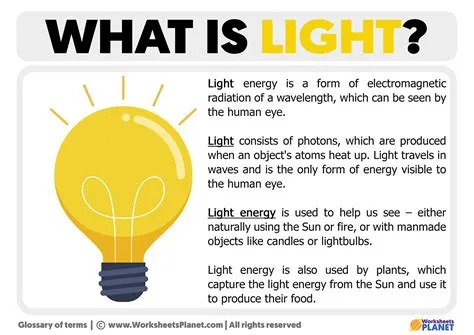
INTERIORDECOR.BIZ.ID – Light is a fundamental aspect of our existence, acting as a primary tool for perception and interaction for countless organisms on Earth. It enables us to see our surroundings, from the grandest celestial bodies to the finest details of the natural world.
Scientifically, light is defined as electromagnetic radiation within a certain portion of the electromagnetic spectrum. This radiation is what our eyes can detect, allowing us to experience vision and interpret the visual cues of our environment.
The Nature of Light
Light exhibits a dual nature, behaving as both a wave and a particle. As a wave, it possesses properties like wavelength and frequency, which determine its color and energy. As a particle, it is composed of tiny packets of energy called photons.
The wave-particle duality is a cornerstone of quantum mechanics, explaining how light can interact with matter in complex ways. Understanding this duality is key to grasping many optical phenomena.
Electromagnetic Spectrum
Visible light, the portion we can see, is only a small part of the broader electromagnetic spectrum. This spectrum includes radio waves, microwaves, infrared radiation, ultraviolet radiation, X-rays, and gamma rays, each with different wavelengths and frequencies.
The Sun is a significant source of electromagnetic radiation across this entire spectrum, impacting Earth in numerous ways. While visible light allows us to see, other forms of radiation have different effects.
The Role of Light in Our World
Light from the Sun is vital for life on Earth, providing the energy that drives weather patterns and sustains ecosystems. Photosynthesis, the process by which plants convert light energy into chemical energy, forms the base of most food chains.
Beyond its biological importance, light is a critical tool for scientific inquiry and technological advancement. Lasers, fiber optics, and cameras all rely on principles of light manipulation.
Light and Perception
Our perception of the world is overwhelmingly dependent on light. The way objects reflect, absorb, or transmit light determines their appearance, including their color, brightness, and texture.
Different organisms have evolved unique ways of utilizing light for survival, from the complex eyes of humans to the light-sensing organs of simpler creatures.
Key Properties of Light
- Speed: Light travels at an astonishing speed of approximately 299,792 kilometers per second (186,282 miles per second) in a vacuum. This speed is constant and is the fastest known speed in the universe.
- Reflection: When light strikes a surface and bounces off, it is called reflection. This is how we see objects that do not produce their own light.
- Refraction: Light bends when it passes from one medium to another, a phenomenon known as refraction. This is why a straw in a glass of water appears bent.
- Diffraction: Light can spread out as it passes through narrow openings or around obstacles, a property called diffraction. This effect is more pronounced with longer wavelengths.
These properties of light are fundamental to understanding optics and how light interacts with various materials. They are the principles behind many optical instruments and natural phenomena.
Light as Energy
Light is a form of energy. The energy carried by a photon is directly proportional to its frequency. Higher frequency light, like ultraviolet or X-rays, carries more energy than lower frequency light, such as radio waves.
This energy transfer is crucial for processes like the warming of the Earth by the Sun and the chemical reactions initiated by light in various biological and industrial applications.
Measuring Light
Light is measured in terms of its intensity, color, and spectral distribution. Photometers and spectrometers are instruments used to quantify these properties, providing valuable data for fields ranging from astronomy to environmental monitoring.
Understanding these measurements allows scientists to analyze light sources, study celestial objects, and assess the impact of light on our environment.
Conclusion
In essence, light is a fundamental force of nature that shapes our perception, fuels life, and drives scientific understanding. Its complex behavior as both a wave and a particle, coupled with its energetic properties, makes it a subject of continuous study and wonder.
From the warmth of the sun to the intricate workings of our vision, light is an indispensable element of the universe and our experience within it.
Frequently Asked Questions about Light
- What is the basic definition of light?
- Light is electromagnetic radiation that is visible to the human eye, and it is a form of energy that travels in waves and particles (photons).
- Is light a wave or a particle?
- Light exhibits both wave-like and particle-like properties, a concept known as wave-particle duality. It can behave as a wave in phenomena like diffraction and interference, and as a particle (photon) in interactions like the photoelectric effect.
- What is the speed of light?
- The speed of light in a vacuum is approximately 299,792 kilometers per second (186,282 miles per second). This speed is a universal constant.
- Why is light important for life on Earth?
- Light, particularly sunlight, is essential for photosynthesis, the process plants use to create energy, forming the base of most food chains. It also provides warmth and regulates Earth’s climate.
- What are some key properties of light?
- Key properties include its constant speed in a vacuum, reflection (bouncing off surfaces), refraction (bending when passing through different media), and diffraction (spreading out).
Written by: Michael Brown