
 ZeckRV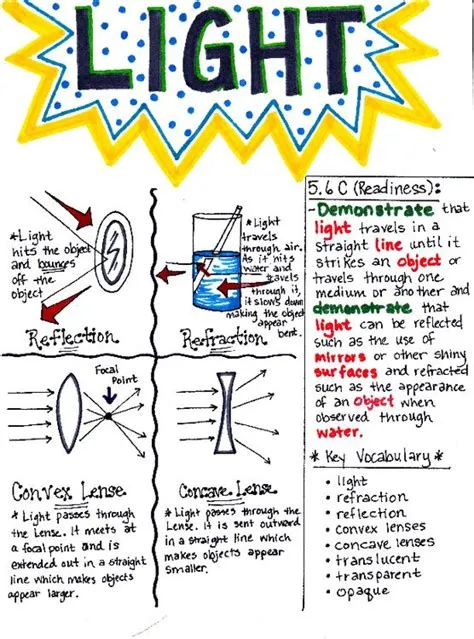
INTERIORDECOR.BIZ.ID – Light is a fundamental part of our world, allowing us to see and interact with everything around us. It’s what makes colors visible and allows us to navigate our surroundings. From the sun warming our planet to the tiny glow of a firefly, light plays a crucial role in life.
Think of light as tiny packets of energy that travel very, very fast. These packets are called photons, and they move in waves, much like ripples on a pond. When these waves reach our eyes, our brains interpret them as sight.
What is Light?
In simple terms, light is a form of energy that we can see. It is part of a spectrum called the electromagnetic spectrum, which includes radio waves, microwaves, and X-rays. Light is the part of this spectrum that our eyes are able to detect.
It’s important to remember that light doesn’t need anything to travel through; it can even travel through the emptiness of space. This is how sunlight reaches Earth, a journey of millions of miles across a vacuum.
Sources of Light
There are two main ways we get light: from natural sources and from artificial sources. Natural sources are things like the sun, stars, and lightning. These produce light on their own without any human help.
Artificial sources of light are things we create, such as light bulbs, candles, and lasers. These devices convert other forms of energy, like electricity or heat, into light. For example, a light bulb uses electricity to make a filament glow brightly.
How Light Travels
Light travels in straight lines, a concept called rectilinear propagation. This is why you can see a shadow when an object blocks the path of light. The shadow is simply the area where the light cannot reach because it’s being blocked.
Imagine shining a flashlight in a dark room; the beam of light travels in a straight, narrow path. If you place your hand in front of the flashlight, a shadow of your hand appears on the wall behind it.
Light and Our Eyes
Our eyes are amazing organs that work like tiny cameras. Light enters our eyes through a small opening called the pupil, then it’s focused by the lens onto the back of the eye, called the retina. The retina contains special cells that detect the light and send signals to our brain.
The brain then processes these signals, allowing us to see shapes, colors, and movement. Without light, our eyes would have nothing to detect, and we wouldn’t be able to see anything at all.
The Importance of Light
Light is essential for almost all life on Earth. Plants use sunlight for photosynthesis, the process of making their own food. This process is the foundation of most food chains, meaning that other living things depend on plants for survival.
Beyond its role in photosynthesis, light also helps regulate our body clocks and influences our moods. Sunlight is a major source of vitamin D, which is important for healthy bones.
Light and Color
We see different colors because light is made up of a spectrum of different colors, like a rainbow. When light hits an object, some colors are absorbed, and others are reflected. The color we see is the color that is reflected back to our eyes.
For instance, a red apple appears red because it absorbs most colors of light but reflects red light. A white object reflects all colors of light, while a black object absorbs almost all colors of light.
Light Phenomena
Light can also bend, a process called refraction, when it passes from one material to another. This is why a straw in a glass of water looks bent at the water’s surface. Light travels at different speeds through different materials.
Another interesting phenomenon is reflection, where light bounces off a surface. This is how we see ourselves in a mirror. The light from our face hits the mirror and bounces back to our eyes.
Conclusion
Understanding light is a fascinating journey into the basic workings of our universe. From its role in seeing to its power to sustain life, light is truly a remarkable phenomenon.
By learning about light, we gain a deeper appreciation for the natural world and the incredible science that makes it all possible.
Frequently Asked Questions about Light
What is light made of?
Light is made of tiny energy packets called photons, which travel in waves.
Can light travel in a circle?
No, light always travels in straight lines unless it is reflected or refracted.
Why is the sky blue?
The sky is blue because air molecules scatter sunlight, and blue light is scattered more than other colors.
Written by: John Smith