
 ZeckRV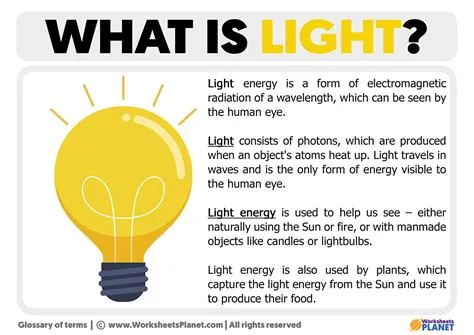
INTERIORDECOR.BIZ.ID – Light is a fundamental concept that plays a crucial role in our daily lives and scientific understanding. As a primary tool for perceiving the world, light allows us to see, interact with our environment, and comprehend the vast universe around us. Understanding its basic definition is essential for grasping various scientific phenomena.
From the distant sun warming our planet to initiating life-sustaining processes, light’s influence is profound and far-reaching. It’s more than just what makes things visible; it’s a form of energy that travels and interacts in fascinating ways. For students in Class 8, grasping the core definition of light opens the door to exploring optics, energy, and the nature of waves.
What is Light?
At its simplest, light is a form of electromagnetic radiation that is visible to the human eye. It’s part of a much larger spectrum of electromagnetic waves, which also includes radio waves, microwaves, infrared radiation, ultraviolet radiation, X-rays, and gamma rays. Our eyes are specifically tuned to detect a narrow band within this spectrum, which we perceive as different colors.
Think of it like tuning a radio to a specific frequency to hear a particular station. Our eyes are like a special receiver that only picks up the “frequencies” of light we can see, ranging from red to violet. Anything outside this range, like radio waves or ultraviolet rays, we cannot see directly without special instruments.
The Dual Nature of Light
One of the most intriguing aspects of light is its dual nature. Scientists describe light as behaving both as a wave and as a particle. This concept, known as wave-particle duality, is central to understanding its behavior in various situations.
As a wave, light exhibits properties like reflection, refraction, and diffraction, similar to how water waves move. As a particle, light is composed of tiny packets of energy called photons. These photons can be thought of as discrete units that carry light energy, and they play a key role in phenomena like the photoelectric effect.
How Light Travels
Light travels in straight lines, a principle known as the law of rectilinear propagation. This is why shadows are formed; when an opaque object blocks light, a region of darkness appears behind it because the light cannot bend around the object.
Imagine a flashlight beam cutting through a dusty room; you can clearly see the straight path the light takes. This straight-line travel is crucial for understanding how we see objects and how optical instruments like mirrors and lenses work.
Sources of Light
Light sources can be broadly categorized into two types: natural and artificial. Natural sources are those that occur without human intervention, with the Sun being the most significant natural source of light for Earth.
Artificial sources are created by humans, such as light bulbs, LEDs, and lasers. These technologies have revolutionized how we illuminate our world, allowing us to function and be productive even when natural light is unavailable.
The Electromagnetic Spectrum
The electromagnetic spectrum encompasses all forms of electromagnetic radiation, ordered by their frequency or wavelength. Visible light occupies only a small portion of this vast spectrum, typically ranging from about 400 nanometers (violet) to 700 nanometers (red) in wavelength.
Understanding the electromagnetic spectrum helps us appreciate that visible light is just one part of a much larger energetic reality. Other parts of the spectrum, like infrared (heat) or ultraviolet (which can cause sunburn), also have significant effects on our world.
Key Properties of Light
Light possesses several key properties that are studied in physics. These include its speed, its ability to travel through a vacuum, and its interaction with matter.
Light travels at an astonishing speed of approximately 299,792 kilometers per second in a vacuum, making it the fastest thing in the universe. This incredible speed allows us to see celestial objects that are light-years away, as their light has traveled for immense periods to reach us.
Interaction with Matter
When light encounters matter, it can be reflected, refracted, absorbed, or transmitted. Reflection is when light bounces off a surface, like a mirror creating an image. Refraction is when light bends as it passes from one medium to another, such as from air to water, which makes a straw in a glass of water appear bent.
Absorption occurs when matter takes in light energy, often converting it into heat. Transmission is when light passes through a substance, like glass, allowing us to see through it. These interactions are fundamental to how we perceive colors and textures.
Why is Light Important?
Light is indispensable for life on Earth. Photosynthesis, the process by which plants convert light energy into chemical energy to grow, is powered by sunlight. Without light, most ecosystems would collapse, and life as we know it would not exist.
Beyond biology, light is essential for human vision, enabling us to navigate our surroundings, appreciate art, and communicate effectively. It also drives technological advancements, from fiber optics to solar power, shaping our modern world.
Summary for Class 8
In summary, light is electromagnetic radiation that we can see. It travels in straight lines, has a dual nature (wave and particle), and comes from sources like the Sun and light bulbs. It interacts with objects through reflection, refraction, absorption, and transmission, and it is vital for life and human perception.
Mastering these basic concepts about light will provide a strong foundation for further exploration in physics and a deeper appreciation for the natural world. It’s a fascinating subject that explains so much about our universe.
Frequently Asked Questions (FAQ)
What is the speed of light?
The speed of light in a vacuum is approximately 299,792 kilometers per second (about 186,282 miles per second).
Can light bend?
Yes, light can bend. This phenomenon is called refraction and occurs when light passes from one medium to another, like from air to water. Light can also bend around obstacles, which is known as diffraction.
What are the colors of visible light?
The colors of visible light, in order of their wavelengths, are red, orange, yellow, green, blue, indigo, and violet (often remembered by the acronym ROY G. BIV).
What is a photon?
A photon is a fundamental particle of light, considered a quantum of the electromagnetic field, which carries energy.
How do we see colors?
We see colors because objects absorb some wavelengths of light and reflect others. Our eyes detect the reflected wavelengths, and our brain interprets them as different colors.
Written by: Olivia Anderson