
 ZeckRV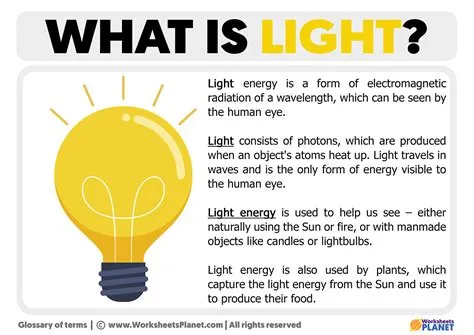
INTERIORDECOR.BIZ.ID – Light is a fundamental aspect of our universe, playing a crucial role in how we perceive and interact with our surroundings. Its definition encompasses electromagnetic radiation that is visible to the human eye. Essentially, it’s what allows us to see the colors, shapes, and textures of the world around us.
From a scientific perspective, light is a form of energy that travels in waves. These waves have specific wavelengths and frequencies, which determine their properties. The electromagnetic spectrum is a broad range of these waves, and visible light occupies a small portion within it.
What is Light?
Light is defined as electromagnetic radiation within a certain portion of the electromagnetic spectrum. It is the visible part of this spectrum to the human eye, meaning we can perceive it and use it to interpret our environment. This visibility is key to our survival and daily activities.
The concept of light can be understood through its dual nature: it behaves as both a wave and a particle. This quantum mechanical property is known as wave-particle duality. As a wave, light exhibits phenomena like diffraction and interference.
The Electromagnetic Spectrum
The electromagnetic spectrum is a continuum of all electromagnetic waves, arranged according to frequency or wavelength. This spectrum includes radio waves, microwaves, infrared radiation, visible light, ultraviolet radiation, X-rays, and gamma rays. Each type of radiation has distinct properties and applications.
Visible light, the portion we can see, ranges from approximately 400 nanometers (violet) to 700 nanometers (red) in wavelength. This narrow band is critical for biological vision and many technological processes.
Properties of Light
One of the most basic properties of light is its speed. In a vacuum, light travels at approximately 299,792 kilometers per second, the fastest speed possible in the universe. This constant speed is a cornerstone of physics, particularly Einstein’s theory of relativity.
Light also exhibits reflection, where it bounces off a surface, and refraction, where it bends as it passes from one medium to another. These properties are fundamental to understanding how lenses work and how we see images.
Color and Wavelength
The color of light is determined by its wavelength. Different wavelengths are perceived by our eyes as different colors. For example, shorter wavelengths are perceived as violet and blue, while longer wavelengths appear as orange and red.
When white light, such as sunlight, passes through a prism, it splits into its constituent colors, creating a spectrum. This phenomenon, known as dispersion, demonstrates that white light is a composite of all colors of the visible spectrum.
Light and Life
Light from the Sun is indispensable for life on Earth. It provides the energy that drives photosynthesis in plants, forming the base of most food chains. Without sunlight, the planet would be a cold, dark, and lifeless place.
Beyond photosynthesis, light influences many biological processes, including circadian rhythms (our internal biological clock) in animals and humans. Exposure to light, especially sunlight, helps regulate sleep-wake cycles and mood.
Applications of Light
The understanding of light has led to countless technological advancements. Lasers, fiber optics, and digital cameras are all reliant on the principles of light. These technologies have revolutionized communication, medicine, and entertainment.
In photography and imaging, light is the medium that captures visual information. Similarly, in astronomy, telescopes collect light from distant celestial objects to study the universe. Light’s ability to carry information is immense.
Conclusion
In summary, light is a complex and vital phenomenon that is central to our existence. Its definition spans from its electromagnetic nature and wave-particle duality to its observable properties like speed, reflection, and color. Understanding light is key to understanding the physical world and the technologies that shape our modern lives.
The continuous study of light, from its fundamental physics to its biological and technological applications, promises further innovation and deeper insights into the universe. Its role as a primary tool for perception and interaction remains unparalleled.
Frequently Asked Questions (FAQ)
What is the basic definition of light?
Light is electromagnetic radiation within the portion of the electromagnetic spectrum that is visible to the human eye, allowing us to see.
What are the two primary ways light behaves?
Light exhibits wave-particle duality, meaning it behaves as both a wave (showing diffraction and interference) and a particle (photons).
What is the speed of light?
In a vacuum, light travels at approximately 299,792 kilometers per second.
How is the color of light determined?
The color of light is determined by its wavelength; shorter wavelengths are perceived as blue and violet, while longer wavelengths appear as red and orange.
Why is sunlight important for life on Earth?
Sunlight is crucial for photosynthesis in plants, which forms the base of most food chains, and it also influences biological rhythms like sleep-wake cycles.
Written by: Sophia Martinez