
 ZeckRV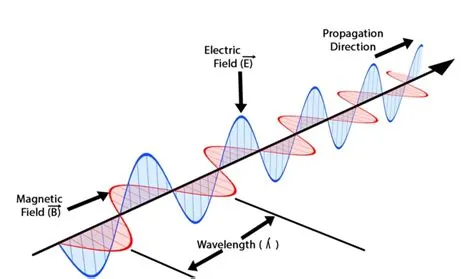
INTERIORDECOR.BIZ.ID – Light is a fundamental aspect of our universe, serving as a primary tool for perception and interaction for countless organisms. It is the invisible force that connects us to distant stars and the vibrant colors that fill our daily lives. Understanding light means understanding a crucial part of physics: electromagnetic waves.
At its core, light is a form of energy that travels in waves, specifically as electromagnetic waves. These waves are not like sound waves, which require a medium to travel through, but can propagate through the vacuum of space. This is why light from the Sun can reach Earth, traversing the vast emptiness of the solar system.
What are Electromagnetic Waves?
Electromagnetic waves are a fundamental concept in physics, representing oscillating electric and magnetic fields that propagate through space. These waves carry energy and momentum from their source. Think of them as ripples on a pond, but instead of water, it’s electric and magnetic fields that are disturbed and spread outward.
The interaction between electric and magnetic fields is what generates and sustains these waves. A changing electric field creates a magnetic field, and a changing magnetic field, in turn, creates an electric field. This continuous interplay allows the wave to travel at the speed of light.
The Electromagnetic Spectrum
Light, as we commonly perceive it, is just a small portion of a much broader phenomenon known as the electromagnetic spectrum. This spectrum encompasses all types of electromagnetic radiation, ordered by their frequency and wavelength.
The electromagnetic spectrum includes radio waves, microwaves, infrared radiation, visible light, ultraviolet radiation, X-rays, and gamma rays. Each of these forms of radiation differs in its energy level and its effects on matter.
Visible Light: Our Window to the World
Visible light is the narrow band of electromagnetic radiation that the human eye can detect. This is the light that allows us to see objects, colors, and the world around us. Different wavelengths within this visible spectrum are perceived by our brains as different colors, forming the rainbow we know so well.
The order of colors in visible light is red, orange, yellow, green, blue, indigo, and violet (ROYGBIV). Red light has the longest wavelength and lowest frequency, while violet light has the shortest wavelength and highest frequency within the visible range.
Properties of Light Waves
Light waves exhibit several key properties, including reflection, refraction, diffraction, and interference. Reflection occurs when light bounces off a surface, like a mirror. Refraction is the bending of light as it passes from one medium to another, such as from air to water.
Diffraction is the bending of light around obstacles or through narrow openings, causing it to spread out. Interference happens when two or more light waves overlap, either reinforcing each other (constructive interference) or canceling each other out (destructive interference).
The Importance of Light
Light from the Sun plays a critical role in sustaining life on Earth. It warms our planet, drives global weather patterns, and initiates photosynthesis, the process by which plants convert light energy into chemical energy.
Beyond its role in biology and meteorology, light is also a cornerstone of modern technology. Lasers, fiber optics, and digital imaging all rely on the controlled manipulation of light waves for their operation.
Light as a Wave-Particle Duality
An intriguing aspect of light is its wave-particle duality. While light behaves as a wave in phenomena like diffraction and interference, it also exhibits particle-like behavior. These light particles are called photons, discrete packets of energy.
The energy of a photon is directly proportional to the frequency of the electromagnetic wave. This duality means that light can be described as both a wave and a stream of particles, a concept that is fundamental to quantum mechanics.
Applications of Light and Electromagnetic Waves
The applications of electromagnetic waves are vast and continue to expand. Radio waves are used for broadcasting communications, while microwaves are used in ovens and telecommunications. Infrared radiation is used in thermal imaging and remote controls.
Ultraviolet light has applications in sterilization and Vitamin D production, though excessive exposure can be harmful. X-rays are crucial in medical imaging, allowing us to see inside the human body, and gamma rays, the most energetic form, are used in cancer treatment and sterilization.
Understanding light and the broader electromagnetic spectrum provides insight into the fundamental workings of the universe. From the warmth of the sun to the images on our screens, light is an indispensable force that shapes our existence and drives innovation.
The study of light as electromagnetic waves continues to unlock new scientific discoveries and technological advancements. Its pervasive influence underscores its importance in both the natural world and human endeavors.
Frequently Asked Questions (FAQ)
What exactly are electromagnetic waves?
Electromagnetic waves are disturbances in electric and magnetic fields that travel through space, carrying energy. They are not dependent on a medium like sound waves and can travel through a vacuum.
Is visible light the only type of electromagnetic wave?
No, visible light is just a small part of the electromagnetic spectrum. Other types include radio waves, microwaves, infrared, ultraviolet, X-rays, and gamma rays, each with different wavelengths and energies.
Why is light important for life on Earth?
Light from the Sun is crucial for life as it provides warmth, drives weather patterns, and is essential for photosynthesis, the process by which plants create food and oxygen.
Can light be considered both a wave and a particle?
Yes, light exhibits wave-particle duality. It behaves like a wave in some experiments (like interference) and like a particle (called a photon) in others. A photon is a discrete packet of energy.
What are some practical applications of electromagnetic waves other than visible light?
Applications are numerous: radio waves for communication, microwaves for heating and telecommunications, infrared for thermal imaging, ultraviolet for sterilization, X-rays for medical imaging, and gamma rays for cancer treatment.
Written by: James Wilson