
 ZeckRV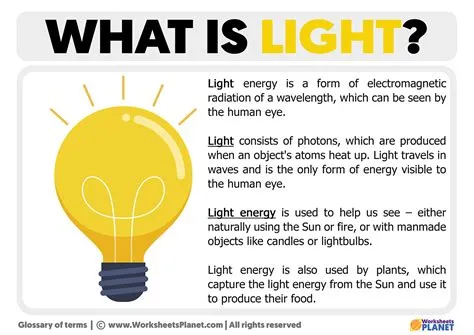
INTERIORDECOR.BIZ.ID – Light is a fundamental phenomenon that allows us to perceive the world around us. For many organisms, light serves as a primary tool for interacting with their environment and understanding their surroundings. As stated in recent scientific contexts, light from sources like the Sun not only illuminates our planet but also plays a crucial role in warming the Earth and driving global weather patterns.
In physics, understanding the definition of light is foundational for many branches of study, from optics to astrophysics. At a grade 10 level, light can be defined as a form of electromagnetic radiation that is visible to the human eye. This radiation travels in waves and also exhibits particle-like properties, a concept known as wave-particle duality.
The Electromagnetic Spectrum
Light is part of a much broader spectrum called the electromagnetic spectrum. This spectrum encompasses all forms of electromagnetic radiation, including radio waves, microwaves, infrared radiation, visible light, ultraviolet radiation, X-rays, and gamma rays. These are all categorized by their wavelength and frequency, which determine their energy and properties.
Visible light, the portion of the spectrum we can see, occupies a very narrow band. Within this band, different wavelengths correspond to different colors, ranging from red (longer wavelengths) to violet (shorter wavelengths). When all these colors are combined, we perceive white light.
Wave Properties of Light
One of the key aspects of light’s definition is its wave nature. Light waves are transverse waves, meaning their oscillations are perpendicular to the direction of energy transfer. They possess characteristics like wavelength, frequency, and amplitude, which are essential for describing their behavior and interactions.
The speed of light in a vacuum, denoted by the symbol ‘c’, is a universal constant, approximately 299,792,458 meters per second. This incredible speed is a fundamental constant in physics, underpinning many theories, including Einstein’s theory of relativity.
Particle Properties of Light
Beyond its wave-like behavior, light also behaves as if it is composed of discrete packets of energy called photons. This particle nature of light is crucial for understanding phenomena like the photoelectric effect, where light strikes a material and causes electrons to be ejected.
Each photon carries a specific amount of energy, which is directly proportional to the frequency of the light. This quantum aspect of light was a revolutionary concept that helped lay the groundwork for quantum mechanics and further expanded our definition of what light truly is.
Key Characteristics of Light
- Electromagnetic Radiation: Light is a form of energy that travels as waves through space.
- Visible Spectrum: It is the portion of the electromagnetic spectrum detectable by the human eye.
- Wave-Particle Duality: Light exhibits both wave-like and particle-like properties.
- Speed of Light: It travels at a constant speed in a vacuum (approximately 3 x 10^8 m/s).
- Photons: Light energy is quantized into discrete packets called photons.
Light and Perception
Our ability to see is entirely dependent on light. Objects either emit their own light, like a lamp or the Sun, or they reflect light that strikes them. This reflected light then travels to our eyes, where it is detected by specialized cells, allowing our brain to form images.
The interaction of light with matter is complex, involving processes such as reflection, refraction, absorption, and diffraction. These interactions are responsible for many optical phenomena we observe daily, from the shimmering of water to the colors of a rainbow.
Applications of Light
Beyond perception, light has countless practical applications that shape our modern world. Technologies such as lasers, fiber optics, and solar panels all rely on a deep understanding of light’s properties.
From medical imaging and telecommunications to renewable energy and industrial processes, the scientific study of light continues to drive innovation and technological advancement across various fields.
Why is Understanding Light Important?
A solid grasp of light’s definition and behavior is essential for students pursuing further studies in physics, engineering, and astronomy. It forms the basis for understanding optics, electromagnetism, and quantum physics.
By comprehending how light works, we gain deeper insights into the universe, from the stars above to the microscopic world of atoms and molecules, reinforcing its role in scientific discovery and technological progress.
Frequently Asked Questions About Light
As we delve into the definition of light for grade 10 students, several common questions arise. Understanding these concepts helps solidify the learning process and address potential areas of confusion.
What is the difference between visible light and other electromagnetic waves?
Visible light is the specific range of electromagnetic radiation that our eyes can detect, whereas other electromagnetic waves have different wavelengths and frequencies and are invisible to us.
Does light always travel in a straight line?
In a uniform medium, light travels in straight lines, known as rays. However, light can bend when it passes through different media (refraction) or around obstacles (diffraction).
What causes different colors of light?
Different colors of light are caused by different wavelengths within the visible spectrum. For example, red light has a longer wavelength than blue light.
Is light a wave or a particle?
Light exhibits both wave-like and particle-like characteristics, a concept known as wave-particle duality. It behaves as a wave in phenomena like interference and diffraction, and as particles (photons) in interactions like the photoelectric effect.
What is the speed of light?
The speed of light in a vacuum is a constant, approximately 299,792,458 meters per second (often rounded to 3 x 10^8 m/s). This speed decreases when light travels through different materials.
How does light help us see?
We see because objects reflect or emit light, which then enters our eyes. Our eyes detect this light, and our brain processes it to create an image of the object.
Frequently Asked Questions (FAQ)
What is the definition of light for a 10th grader?
For a 10th grader, light can be defined as a form of electromagnetic radiation that is visible to the human eye, traveling in waves and also behaving like particles called photons.
Is light a wave or a particle?
Light exhibits both wave-like and particle-like properties, a concept known as wave-particle duality. It can behave as a wave in some situations and as a particle (photon) in others.
What is the speed of light?
The speed of light in a vacuum is approximately 299,792,458 meters per second, often rounded to 3 x 10^8 m/s. It slows down when traveling through different materials.
What are the different colors of light?
The different colors of light correspond to different wavelengths within the visible spectrum. Red has a longer wavelength, while violet has a shorter wavelength.
How does light interact with objects to allow us to see them?
We see objects because they either emit their own light or reflect light that strikes them. This reflected light enters our eyes, and our brain interprets it as an image.
Written by: Sarah Davis