
 ZeckRV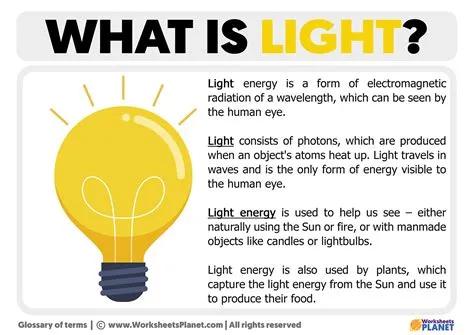
INTERIORDECOR.BIZ.ID – Light is a fundamental aspect of our universe, enabling us to perceive the world around us. It is a form of electromagnetic radiation that makes vision possible for many organisms. Understanding its definition is the first step to appreciating its profound impact.
Broadly defined, light is the visible part of the electromagnetic spectrum that human eyes can detect. This spectrum also includes other forms of radiation like radio waves, microwaves, infrared, ultraviolet, X-rays, and gamma rays, all of which have different wavelengths and frequencies. Light from the Sun plays a crucial role in warming the Earth, driving weather patterns, and initiating life-sustaining processes.
What is Light?
In physics, light is described as a stream of photons, which are massless elementary particles that act as quanta of the electromagnetic field. These photons travel at a constant speed in a vacuum, approximately 299,792 kilometers per second, which is the fastest speed anything can travel in the universe. This speed is often denoted by the symbol ‘c’.
Light exhibits a dual nature, behaving as both a wave and a particle. As a wave, it has properties such as wavelength, frequency, and amplitude, which determine its color and intensity. As a particle, it consists of discrete energy packets called photons.
Wave-Particle Duality Explained
The wave-like behavior of light is evident in phenomena like diffraction and interference, where light bends around obstacles or spreads out. These characteristics are best described using wave equations.
Conversely, the particle-like behavior is observed in the photoelectric effect, where light strikes a metal surface and ejects electrons. This effect is explained by light behaving as discrete packets of energy, or photons.
Properties of Light
Light travels in straight lines, a property known as rectilinear propagation. This is why shadows are formed when an opaque object blocks light.
Another key property is reflection, where light bounces off a surface. The angle at which light hits a surface (angle of incidence) is equal to the angle at which it bounces off (angle of reflection).
Refraction is the bending of light as it passes from one medium to another, such as from air to water. This phenomenon occurs because the speed of light changes in different materials.
Dispersion is the splitting of white light into its constituent colors, as seen in a prism. This happens because different wavelengths of light are refracted at slightly different angles.
The Electromagnetic Spectrum
Visible light occupies a narrow band within the much broader electromagnetic spectrum. This spectrum is organized by wavelength and frequency, with longer wavelengths corresponding to lower frequencies and shorter wavelengths to higher frequencies.
Beyond visible light, we have infrared radiation, which we feel as heat, and ultraviolet radiation, which can cause sunburn. These are all part of the same fundamental phenomenon of electromagnetic waves.
The Importance of Light
Light is indispensable for life on Earth, primarily through photosynthesis. Plants use sunlight to convert carbon dioxide and water into energy, forming the base of most food chains.
For humans and many other animals, light is essential for sight, allowing us to navigate, find food, and communicate. It also influences our biological rhythms, such as our sleep-wake cycles.
Light also plays a critical role in technology, from fiber optics that enable high-speed internet to lasers used in everything from barcode scanners to medical surgery. Its ability to carry information and energy makes it a cornerstone of modern innovation.
Conclusion
In essence, light is a versatile and powerful force that shapes our perception, sustains life, and drives technological advancement. Its dual nature as both a wave and a particle, along with its fundamental properties, makes it a fascinating subject of scientific study.
From the warmth of the sun to the images on our screens, light is an omnipresent and vital component of our existence. Continued exploration of its mysteries promises further breakthroughs in science and technology.
Frequently Asked Questions about Light
What is the speed of light? The speed of light in a vacuum is approximately 299,792 kilometers per second, often denoted as ‘c’.
Why does light bend when it enters water? Light bends due to refraction, which occurs because its speed changes as it passes from one medium (like air) to another (like water).
What is the difference between visible light and other electromagnetic waves? Visible light is the portion of the electromagnetic spectrum that the human eye can detect, while other waves like radio waves or X-rays have different wavelengths and frequencies and are not visible.
How does light enable us to see? Light reflects off objects and enters our eyes, stimulating the retina and sending signals to the brain which interprets them as images.
What is the photoelectric effect? The photoelectric effect is a phenomenon where electrons are emitted from a material when light shines on it, demonstrating light’s particle-like nature.
Frequently Asked Questions (FAQ)
What is the speed of light?
The speed of light in a vacuum is approximately 299,792 kilometers per second, often denoted as ‘c’.
Why does light bend when it enters water?
Light bends due to refraction, which occurs because its speed changes as it passes from one medium (like air) to another (like water).
What is the difference between visible light and other electromagnetic waves?
Visible light is the portion of the electromagnetic spectrum that the human eye can detect, while other waves like radio waves or X-rays have different wavelengths and frequencies and are not visible.
How does light enable us to see?
Light reflects off objects and enters our eyes, stimulating the retina and sending signals to the brain which interprets them as images.
What is the photoelectric effect?
The photoelectric effect is a phenomenon where electrons are emitted from a material when light shines on it, demonstrating light’s particle-like nature.
Written by: John Smith