
 ZeckRV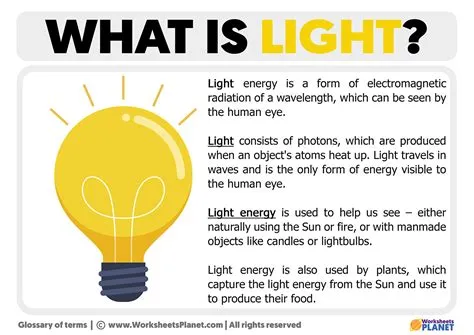
INTERIORDECOR.BIZ.ID – Light is a fundamental aspect of our universe, playing a crucial role in how we perceive and interact with the world around us. Simply put, light is a form of electromagnetic radiation that makes vision possible.
It’s the radiant energy that allows our eyes to detect objects, colors, and shapes, forming the basis of our visual experience. Without light, the world would be an incomprehensible darkness.
Understanding Electromagnetic Radiation
To define light more precisely, we can understand it as a part of the electromagnetic spectrum. This spectrum encompasses all forms of electromagnetic radiation, arranged by wavelength and frequency.
Visible light, the portion we can see, occupies a narrow band within this vast spectrum, ranging from violet to red hues.
The Nature of Light
Light exhibits a dual nature, behaving as both a wave and a particle. As a wave, it propagates through space with characteristic properties like wavelength and frequency.
As a particle, it is composed of discrete packets of energy called photons, which interact with matter.
The Spectrum of Light
The electromagnetic spectrum includes many forms of energy beyond visible light, such as radio waves, microwaves, infrared radiation, ultraviolet radiation, X-rays, and gamma rays.
Each of these forms has a different wavelength and energy level, with visible light being the portion that stimulates the retina of the human eye.
Sources of Light
The most prominent source of light for Earth is the Sun. Solar radiation provides not only the light we see but also heat that drives our planet’s climate.
Other sources include artificial lights like incandescent bulbs, LEDs, and lasers, as well as natural phenomena like lightning and bioluminescence.
The Importance of Light
Light is indispensable for life on Earth. Photosynthesis, the process by which plants convert light energy into chemical energy, forms the base of most food chains.
It also regulates circadian rhythms in organisms, influencing sleep-wake cycles and other biological processes.
Light and Perception
Our ability to see is entirely dependent on light reflecting off objects and entering our eyes. The brain then interprets these signals as images.
The perception of color is determined by the wavelengths of light that an object reflects or emits.
Beyond Vision: Light’s Wider Impact
Beyond enabling vision and supporting life, light plays a role in various scientific and technological applications. Lasers, for instance, utilize concentrated beams of light for everything from surgery to data storage.
Understanding the properties of light is crucial for fields like optics, astronomy, and telecommunications.
Light as Energy
Light carries energy, and this energy can be converted into other forms. Solar panels, for example, convert light energy from the sun directly into electricity.
This renewable energy source highlights the practical applications of harnessing light’s power.
Conclusion
In summary, light is a vital form of electromagnetic radiation essential for vision, life, and numerous technological advancements. Its dual wave-particle nature and its presence across the electromagnetic spectrum underscore its complexity and importance.
From warming our planet to enabling us to read this text, light is a constant and indispensable force in our daily existence.
Frequently Asked Questions about Light
Here are some common questions about the nature and impact of light.
What is the fastest thing in the universe?
The speed of light in a vacuum is the fastest speed at which all energy, matter, and information can travel.
How does light help plants grow?
Plants use light energy during photosynthesis to convert carbon dioxide and water into glucose (sugar) and oxygen.
What are the different colors of light?
The visible spectrum of light includes the colors red, orange, yellow, green, blue, indigo, and violet, which can be seen in a rainbow.
Can light be seen in outer space?
Yes, light from stars and other celestial bodies travels through the vacuum of space, making them visible to us on Earth.
What is the difference between light and heat?
While light is a form of electromagnetic radiation, heat is the transfer of thermal energy. However, light can carry energy and thus can contribute to heat.
Frequently Asked Questions (FAQ)
What is the fastest thing in the universe?
The speed of light in a vacuum is the fastest speed at which all energy, matter, and information can travel.
How does light help plants grow?
Plants use light energy during photosynthesis to convert carbon dioxide and water into glucose (sugar) and oxygen.
What are the different colors of light?
The visible spectrum of light includes the colors red, orange, yellow, green, blue, indigo, and violet, which can be seen in a rainbow.
Can light be seen in outer space?
Yes, light from stars and other celestial bodies travels through the vacuum of space, making them visible to us on Earth.
What is the difference between light and heat?
While light is a form of electromagnetic radiation, heat is the transfer of thermal energy. However, light can carry energy and thus can contribute to heat.
Written by: James Wilson