
 ZeckRV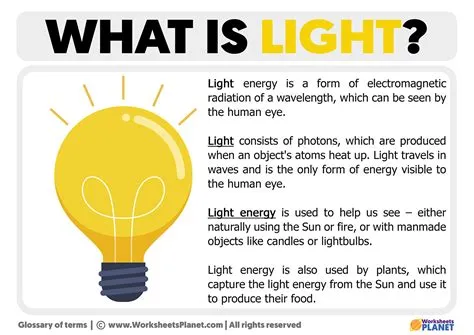
INTERIORDECOR.BIZ.ID – Light is a fundamental aspect of our universe, playing a crucial role in how we perceive the world and interact with it. Essentially, the light definition meaning refers to electromagnetic radiation that is visible to the human eye.
This visible spectrum is just a small part of a much broader range of electromagnetic waves, including radio waves, microwaves, infrared, ultraviolet, X-rays, and gamma rays. Light allows organisms to see their surroundings, facilitating navigation, foraging, and predator avoidance.
The Nature of Light
Scientifically, light exhibits a dual nature, behaving as both a wave and a particle. As a wave, it possesses properties like wavelength and frequency, which determine its color and energy. The different wavelengths of visible light are what our eyes interpret as distinct colors, from red with longer wavelengths to violet with shorter ones.
As a particle, light is composed of discrete packets of energy called photons. These photons carry energy and momentum, and their interaction with matter explains many optical phenomena like reflection and absorption. The constant emission of photons from a light source is what enables illumination.
Light as Electromagnetic Radiation
The concept of light being electromagnetic radiation means it is a form of energy that travels through space as oscillating electric and magnetic fields. These fields propagate at the speed of light, a universal constant that is incredibly fast.
This characteristic allows light to travel vast distances, such as the energy from the Sun reaching Earth. The Sun’s light is not only vital for vision but also a primary driver of Earth’s climate and weather systems.
The Spectrum of Light
The electromagnetic spectrum categorizes these waves based on their wavelength and frequency. Visible light occupies a narrow band within this spectrum, typically ranging from about 380 nanometers (violet) to 740 nanometers (red).
Beyond the visible spectrum lie other forms of electromagnetic radiation. Infrared radiation, for example, is experienced as heat, while ultraviolet radiation can cause sunburn. Understanding the spectrum helps us appreciate the full range of energy light encompasses.
Sources of Light
Sources of light can be broadly categorized into two types: luminous and illuminated. Luminous sources, like the Sun, stars, or light bulbs, produce their own light through various physical processes such as nuclear fusion or incandescence.
Illuminated objects, on the other hand, do not produce light but reflect it from luminous sources. This is why we can see non-luminous objects like furniture or trees; they reflect ambient light into our eyes.
Light and Life
The Sun’s light is indispensable for life on Earth, initiating processes like photosynthesis in plants. Photosynthesis converts light energy into chemical energy, forming the base of most food chains and producing the oxygen we breathe.
Furthermore, light influences biological rhythms in many organisms, including humans, through a process known as the circadian rhythm. The absence or presence of light signals to our bodies when to be awake and when to sleep.
Applications of Light
Beyond its natural roles, human understanding of light has led to countless technological advancements. Optics, the study of light, has given us tools like telescopes, microscopes, and cameras, expanding our vision and knowledge.
Lasers, which produce highly focused and coherent beams of light, have revolutionized fields from surgery to data storage and telecommunications. Fiber optics, transmitting data through light pulses, is the backbone of the internet.
In Summary
The light definition meaning encapsulates a fundamental force of nature. It is visible electromagnetic radiation that allows for perception, drives essential biological and climatic processes, and forms the basis for many of our most important technologies.
From warming our planet to enabling us to see the stars, light’s significance cannot be overstated. Its study continues to unlock new frontiers in science and innovation.
Frequently Asked Questions (FAQ)
What is the basic definition of light?
The basic definition of light is electromagnetic radiation that is visible to the human eye, allowing us to perceive our surroundings.
What are the two main properties of light?
Light exhibits a dual nature, behaving as both a wave (with properties like wavelength and frequency) and a particle (composed of photons).
What is the electromagnetic spectrum?
The electromagnetic spectrum is a range of all types of electromagnetic radiation, categorized by their wavelength and frequency, with visible light being a small portion of it.
What is the difference between luminous and illuminated objects?
Luminous objects produce their own light (e.g., the Sun), while illuminated objects reflect light from other sources (e.g., a book).
How is light essential for life on Earth?
Light, particularly from the Sun, is crucial for photosynthesis in plants, which produces food and oxygen, and it also influences biological rhythms.
Written by: Emma Johnson