
 ZeckRV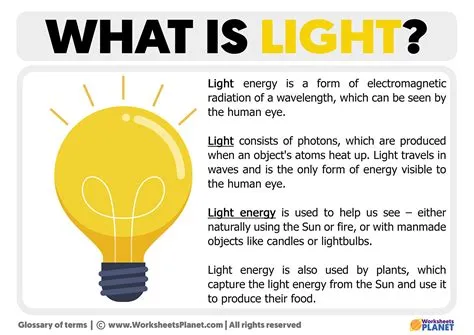
INTERIORDECOR.BIZ.ID – Light is a fundamental concept in science, crucial for our understanding of the universe and how we interact with it. At its core, the definition of light refers to electromagnetic radiation that is visible to the human eye. This visible spectrum is just a small part of a much larger range of electromagnetic waves.
As a primary tool for perceiving the world, light allows organisms to see their surroundings and navigate their environments. Without light, our visual sense would be rendered useless, profoundly limiting our interaction with the physical realm. The sun, a primary source of light for Earth, plays an indispensable role in sustaining life.
The Nature of Light
Understanding the definition of light involves recognizing its dual nature as both a wave and a particle. This concept, known as wave-particle duality, is a cornerstone of quantum mechanics. It explains many of the phenomena associated with light that classical physics could not.
As a wave, light exhibits properties like diffraction and interference, similar to other types of waves such as sound or water waves. These wave characteristics are essential for understanding how light travels through space and interacts with objects. It propagates as oscillating electric and magnetic fields.
Light as a Particle (Photon)
Conversely, light also behaves as a stream of discrete energy packets called photons. Each photon carries a specific amount of energy determined by its frequency. This particle nature is evident in phenomena like the photoelectric effect, where light can eject electrons from a material.
The energy of a photon is directly proportional to the frequency of the light, a relationship described by Planck’s equation. This means higher frequency light, like blue or violet, carries more energy per photon than lower frequency light, such as red.
The Electromagnetic Spectrum
The definition of light often expands to encompass the broader electromagnetic spectrum. This spectrum includes all forms of electromagnetic radiation, ordered by their frequency and wavelength. Visible light is a narrow band within this vast spectrum.
Other forms of electromagnetic radiation include radio waves, microwaves, infrared radiation, ultraviolet light, X-rays, and gamma rays. While invisible to our eyes, these forms of radiation share the same fundamental nature as visible light and travel at the same speed in a vacuum.
Visible Light and Color
Visible light is the portion of the electromagnetic spectrum that human eyes can detect. This light ranges in wavelength from approximately 380 nanometers (violet) to 750 nanometers (red). The perception of different colors is our brain’s interpretation of different wavelengths within this visible range.
White light, such as sunlight, is a composite of all the colors of the visible spectrum. When white light passes through a prism, it can be separated into its constituent colors, demonstrating this spectral composition. Different colors correspond to different energy levels and wavelengths of photons.
The Importance of Light
Beyond perception, light plays a critical role in numerous natural processes. The sun’s light provides the energy that drives Earth’s climate systems and weather patterns. This solar energy is also the foundation of most ecosystems on our planet.
Photosynthesis, the process by which plants convert light energy into chemical energy, is a prime example of light’s life-sustaining function. This process forms the base of the food chain, supporting countless organisms.
Applications of Light
The study and application of light have led to numerous technological advancements. Lasers, fiber optics, and LED lighting are just a few examples of technologies directly related to understanding and manipulating light.
From medical imaging using X-rays to communication via radio waves, our interaction with and understanding of the electromagnetic spectrum, including visible light, continues to shape our modern world and future innovations.
Frictionless Movement
Light can be thought of as moving without friction through the vacuum of space. Unlike physical objects that encounter resistance, light travels unimpeded until it interacts with matter. This property allows us to see distant stars and galaxies.
The speed of light in a vacuum is a universal constant, approximately 299,792 kilometers per second. This constant speed is a fundamental aspect of Einstein’s theory of relativity and underpins much of modern physics.
Interaction with Matter
When light encounters matter, several interactions can occur. It can be reflected, absorbed, or transmitted. Reflection is what allows us to see objects, as light bounces off their surfaces and into our eyes.
Absorption occurs when matter takes in light energy, often converting it into heat. Transmission happens when light passes through a substance, as seen when light travels through glass or water. The way light interacts with a material determines its color and other visual properties.
Historical Perspective
The definition and understanding of light have evolved significantly throughout history. Early philosophers debated its nature, with some believing it consisted of particles and others proposing it was a wave phenomenon. Isaac Newton famously championed the particle theory of light.
Later, scientists like Christiaan Huygens proposed a wave theory, and by the 19th century, experiments by James Clerk Maxwell unified electricity, magnetism, and light, solidifying the wave theory. The advent of quantum mechanics in the 20th century revealed the dual nature of light, integrating both wave and particle concepts.
The Future of Light Research
Ongoing research into light continues to push the boundaries of scientific knowledge and technological innovation. Fields like quantum optics and photonics are exploring new ways to generate, manipulate, and detect light with unprecedented precision.
These advancements promise revolutionary applications in areas such as quantum computing, advanced imaging, secure communication, and more efficient energy technologies, all stemming from a deeper understanding of the fundamental definition and behavior of light.
In summary, the definition of light is multifaceted, encompassing its role as electromagnetic radiation, its wave-particle duality, and its profound impact on life and technology. Its journey from ancient philosophical inquiry to the cutting edge of modern science underscores its enduring importance.
Light is a primary tool for perceiving the world and interacting with it for many organisms. Light from the Sun warms the Earth, drives global weather patterns, and initiates the life-sustaining processes that make our planet habitable.
Frequently Asked Questions (FAQ)
What is the basic definition of light?
The basic definition of light is electromagnetic radiation that is visible to the human eye. It’s a form of energy that travels in waves and also behaves as particles called photons.
Is light a wave or a particle?
Light exhibits wave-particle duality, meaning it can behave as both a wave and a particle depending on the phenomenon being observed. This is a fundamental concept in quantum mechanics.
What is the electromagnetic spectrum?
The electromagnetic spectrum is the range of all types of electromagnetic radiation, including radio waves, microwaves, infrared, visible light, ultraviolet, X-rays, and gamma rays, ordered by their frequency and wavelength.
Why is light important for life on Earth?
Light, particularly from the sun, is essential for life as it drives photosynthesis in plants, which forms the base of the food chain. It also warms the Earth and influences weather patterns.
What are photons?
Photons are discrete packets or quanta of electromagnetic energy. They are the fundamental particles of light, carrying energy and momentum.
What is the speed of light?
The speed of light in a vacuum is a universal constant, approximately 299,792 kilometers per second (about 186,282 miles per second).
How do we see colors?
We see colors because our eyes can detect different wavelengths of visible light. Our brain interprets these different wavelengths as distinct colors, ranging from violet to red.
Written by: Sarah Davis