
 ZeckRV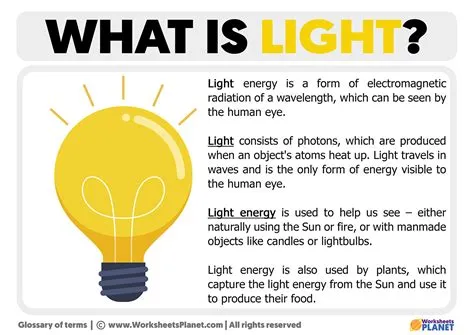
INTERIORDECOR.BIZ.ID – Light is a fundamental aspect of our universe, playing a crucial role in how we perceive and interact with the world around us. Scientifically, light can be defined as a form of electromagnetic radiation that is visible to the human eye. It is this radiant energy that allows us to see colors, shapes, and the vast expanse of our environment.
The concept of light dates back centuries, with various theories attempting to explain its nature and behavior. Today, we understand light as having a dual nature, exhibiting properties of both waves and particles, a concept known as wave-particle duality. This makes light a fascinating subject in the realm of physics and a critical component for life on Earth.
The Nature of Light
Light travels in waves, much like ripples on water or sound waves through the air. These waves have specific wavelengths and frequencies, which determine their characteristics and how we perceive them. The electromagnetic spectrum encompasses all types of light, from radio waves with long wavelengths to gamma rays with very short wavelengths.
Visible light occupies a small portion of this spectrum, ranging from red light with longer wavelengths to violet light with shorter wavelengths. When white light passes through a prism, it separates into these different colors, demonstrating its composite nature. This phenomenon is the basis of rainbows and our understanding of color.
Wave-Particle Duality Explained
While light behaves as a wave when it travels, it also exhibits particle-like behavior. These particles of light are called photons, and they carry discrete amounts of energy. Photons are responsible for phenomena like the photoelectric effect, where light striking a metal surface can eject electrons.
The wave-particle duality of light is a cornerstone of quantum mechanics, illustrating that seemingly contradictory properties can coexist. Understanding this duality is key to comprehending many optical phenomena and the behavior of light at the atomic level.
Properties of Light
One of the most remarkable properties of light is its speed. In a vacuum, light travels at approximately 299,792 kilometers per second, making it the fastest entity in the universe. This constant speed is a fundamental principle in Einstein’s theory of relativity.
Light also exhibits reflection and refraction. Reflection occurs when light bounces off a surface, like a mirror, allowing us to see our image. Refraction, on the other hand, happens when light bends as it passes from one medium to another, such as from air into water, which is why a straw appears bent in a glass of water.
Interaction with Matter
When light interacts with matter, several things can happen, including absorption, transmission, and scattering. Absorption occurs when matter takes in light energy, often converting it into heat, which is why dark surfaces feel warmer in sunlight. Transmission is when light passes through a substance, as seen with clear glass or water.
Scattering happens when light is deflected in various directions upon encountering particles or irregularities in a medium. This is why the sky appears blue; sunlight is scattered by the molecules in the Earth’s atmosphere, with blue light scattering more effectively than other colors.
The Importance of Light for Life
Light from the Sun is the primary energy source for Earth, driving weather patterns and sustaining ecosystems. Photosynthesis, the process by which plants convert light energy into chemical energy, forms the base of most food chains.
Beyond its biological necessity, light is our primary means of sensory perception. It allows us to navigate, communicate, and appreciate the beauty of the natural world. Without light, our understanding of reality would be profoundly different.
Light in Technology and Science
The study of light, or optics, has led to numerous technological advancements. From eyeglasses and telescopes to lasers and fiber optics, understanding light has revolutionized communication, medicine, and industry.
Lasers, for instance, produce a highly focused beam of light that has applications ranging from reading barcodes to performing delicate surgeries. Fiber optics transmit data as pulses of light, forming the backbone of the internet and modern telecommunications.
Conclusion
In essence, light is a versatile and powerful force that shapes our planet and our lives. Its dual nature as both a wave and a particle, coupled with its remarkable properties, continues to fascinate scientists and engineers.
From enabling vision and sustaining life through photosynthesis to powering advanced technologies, the definition of light extends far beyond a mere physical phenomenon. It is a fundamental element that connects us to the universe and drives progress in countless fields.
Frequently Asked Questions About Light
What is the speed of light?
The speed of light in a vacuum is approximately 299,792 kilometers per second.
What are the two main properties of light?
Light exhibits wave-like properties (wavelength and frequency) and particle-like properties (photons).
How does light enable us to see?
Light reflects off objects and enters our eyes, where it is processed by the brain to form images.
What is photosynthesis?
Photosynthesis is the process by which plants use sunlight, water, and carbon dioxide to create their own food (energy) and release oxygen.
Can light bend?
Yes, light bends when it passes from one medium to another, a phenomenon called refraction.
Frequently Asked Questions (FAQ)
What is the basic definition of light?
Light is a form of electromagnetic radiation that is visible to the human eye, enabling us to perceive the world.
What are the two fundamental natures of light?
Light exhibits wave-particle duality, meaning it can behave as both a wave and a particle (photon).
What is the speed of light in a vacuum?
The speed of light in a vacuum is approximately 299,792 kilometers per second.
How does light interact with objects?
Light can be reflected, refracted, absorbed, transmitted, or scattered when it interacts with matter.
Why is light important for life on Earth?
Light from the Sun is crucial for photosynthesis, which forms the base of most food chains, and it is our primary tool for perception.
What are some applications of understanding light?
Understanding light has led to technologies like lasers, fiber optics, cameras, and eyeglasses.
Written by: Sophia Martinez