
 ZeckRV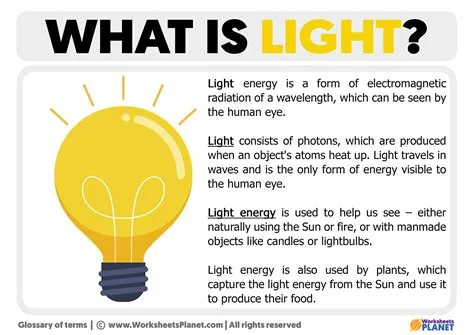
INTERIORDECOR.BIZ.ID – Light serves as a primary tool for both perceiving and interacting with the world around us for a vast array of organisms. It is an electromagnetic radiation that allows us to see, and it plays an essential role in numerous natural processes. From the warmth it provides to the energy it carries, light is fundamental to life on Earth.
Historically, understanding light has been a continuous journey of scientific inquiry. Early philosophers and scientists grappled with its nature, proposing various theories to explain its behavior. These historical debates laid the groundwork for the more sophisticated models we use today.
What is Light?
At its core, light is a form of electromagnetic radiation. This means it is composed of oscillating electric and magnetic fields that propagate through space. Light travels at an incredibly high speed, approximately 299,792,458 meters per second in a vacuum, making it the fastest thing in the universe.
The spectrum of light that humans can see is known as visible light. This visible spectrum is a small part of a much larger range of electromagnetic waves, which includes radio waves, microwaves, infrared radiation, ultraviolet radiation, X-rays, and gamma rays. Each of these has different wavelengths and frequencies.
The Dual Nature of Light
One of the most fascinating aspects of light is its dual nature, behaving as both a wave and a particle. This concept, known as wave-particle duality, is a cornerstone of quantum mechanics.
As a wave, light exhibits phenomena like diffraction and interference, similar to water waves. These wave-like properties are responsible for behaviors such as the bending of light around obstacles and the formation of colorful patterns when light passes through narrow slits.
As a particle, light is composed of discrete packets of energy called photons. Each photon carries a specific amount of energy, which is directly proportional to the frequency of the light. This particle nature explains how light interacts with matter, such as when it excites electrons in atoms.
Properties of Light
Light possesses several key properties that define its behavior. These include its speed, wavelength, frequency, and intensity.
Wavelength refers to the distance between successive crests of a light wave, while frequency denotes the number of waves that pass a point per second. These two properties are inversely related; longer wavelengths correspond to lower frequencies, and shorter wavelengths correspond to higher frequencies.
Color and Perception
The color of light is determined by its wavelength. Different wavelengths within the visible spectrum are perceived by the human eye and brain as different colors, ranging from red (longer wavelengths) to violet (shorter wavelengths).
When light interacts with objects, some wavelengths are absorbed, while others are reflected. The color we see an object is the color of the light that is reflected from its surface. For example, a red apple appears red because it absorbs most wavelengths of visible light but reflects red wavelengths.
Light’s Role in the Universe
Light from the Sun is the primary source of energy for Earth, warming the planet and driving global weather patterns. It is also the initiator of life-sustaining processes, most notably photosynthesis in plants.
Beyond our planet, light allows us to observe distant stars, galaxies, and other celestial objects. The study of light, or optics, is crucial in astronomy and physics, enabling us to understand the composition, distance, and movement of the universe.
Interaction with Matter
Light interacts with matter in various ways, including absorption, reflection, refraction, and scattering. These interactions are fundamental to many everyday phenomena and technological applications.
Absorption occurs when matter takes up the energy of light, often converting it into heat. Reflection is when light bounces off a surface, which is how we see most objects. Refraction is the bending of light as it passes from one medium to another, like from air to water.
Applications of Light
The understanding of light has led to countless technological advancements. From the lenses in our eyes and cameras to fiber optics used for high-speed internet, light technology is ubiquitous.
Lasers, which produce coherent beams of light, have applications in medicine, industry, and entertainment. Medical imaging techniques like X-rays also rely on different forms of electromagnetic radiation, closely related to visible light.
In summary, light is a fundamental physical phenomenon with a dual wave-particle nature. It is crucial for perception, energy transfer, and understanding the cosmos. Its properties and interactions with matter are the basis for numerous natural phenomena and human innovations.
Further exploration into optics, quantum physics, and electromagnetism can reveal even deeper insights into the intricate and marvelous nature of light.
This foundational knowledge of light is essential for students and professionals across various scientific and technical fields.
The continuous study of light promises further discoveries and advancements in our understanding of the universe.
Understanding light definition of light is key to unlocking many scientific principles.
The electromagnetic spectrum provides a broader context for understanding light’s place in nature.
Light’s journey from the Sun to Earth sustains life in myriad ways.
The ability to manipulate light has revolutionized communication and data transfer.
In essence, light is more than just illumination; it’s a fundamental force shaping our reality.
The precise measurement of light speed remains a testament to human ingenuity.
Exploring light’s properties allows for the design of advanced optical instruments.
The concept of photons revolutionized our understanding of energy and matter.
Light’s interaction with different materials dictates their observable characteristics.
The fundamental definition of light underpins much of modern science and technology.
Frequently Asked Questions (FAQ)
What is the basic definition of light?
Light is a form of electromagnetic radiation that allows us to see and interacts with the world. It consists of oscillating electric and magnetic fields that travel as waves and can also be described as discrete packets of energy called photons.
What are the two main ways light behaves?
Light behaves as both a wave and a particle. As a wave, it exhibits phenomena like diffraction and interference. As a particle, it is composed of photons, discrete energy packets.
What determines the color of light?
The color of light is determined by its wavelength. Different wavelengths within the visible spectrum are perceived by the human eye as different colors, from red to violet.
How fast does light travel?
Light travels at approximately 299,792,458 meters per second in a vacuum, making it the fastest known entity in the universe.
What is the role of light in nature?
Light from the Sun warms the Earth, drives weather patterns, and is essential for photosynthesis, which sustains life. It also allows organisms to perceive their environment.
Written by: Sophia Martinez