
 ZeckRV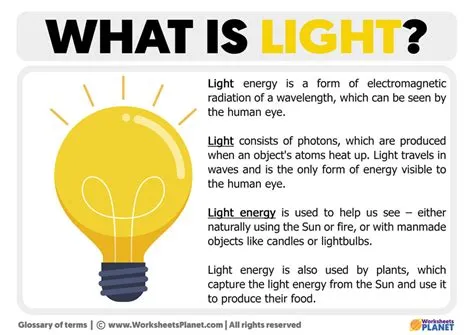
INTERIORDECOR.BIZ.ID – Light is a fundamental aspect of our universe, playing a crucial role in how we perceive and interact with the world around us. In physics, light is understood as a form of electromagnetic radiation that is visible to the human eye. This radiation travels in waves, much like ripples on the surface of water, and also exhibits particle-like properties, behaving as tiny packets of energy called photons.
The concept of light being both a wave and a particle is known as wave-particle duality, a cornerstone of quantum mechanics. As a wave, light has properties like wavelength, which determines its color, and frequency, which relates to its energy. As a particle, each photon carries a discrete amount of energy.
What is Light?
At its core, a simple physics definition of light is that it is electromagnetic radiation within the portion of the electromagnetic spectrum that can be detected by the human eye. This visible light is what allows us to see colors, shapes, and the environment. It is generated by the movement of charged particles, such as electrons, typically when they change energy levels.
Light travels at an incredible speed, approximately 299,792 kilometers per second in a vacuum, making it the fastest thing in the universe. This speed is a constant, a fundamental limit that nothing with mass can surpass. When light passes through different materials, its speed can change, which causes it to bend or refract.
The Electromagnetic Spectrum
Light is just a small part of a much broader spectrum of electromagnetic radiation. This spectrum includes radio waves, microwaves, infrared radiation, visible light, ultraviolet radiation, X-rays, and gamma rays, all of which are waves of energy that travel at the speed of light.
Each type of electromagnetic radiation has a different wavelength and frequency. Radio waves have long wavelengths and low frequencies, while gamma rays have very short wavelengths and high frequencies. Visible light sits neatly in the middle, allowing us to see.
How Light Interacts with Matter
When light encounters an object, it can be reflected, absorbed, or transmitted. Reflection is what allows us to see objects that do not emit their own light; the light bounces off their surface and into our eyes. Absorption occurs when an object takes in the light’s energy, often converting it into heat, which is why dark objects tend to get warmer in sunlight.
Transmission happens when light passes through a material, such as glass or water. The way light interacts with matter is dependent on the properties of both the light and the material. For instance, transparent materials allow most light to pass through, while opaque materials block it entirely.
The Importance of Light
Light from the Sun is not just for vision; it’s a vital energy source for life on Earth. Photosynthesis, the process by which plants convert light energy into chemical energy, forms the base of most food chains. Without sunlight, plants couldn’t grow, and the entire ecosystem would collapse.
Beyond its biological roles, light plays a significant part in many natural phenomena and technological advancements. The warmth from the sun, driven by light, influences global weather patterns and climate. Our understanding of light has led to inventions like lasers, fiber optics, and digital cameras.
Applications of Light
In medicine, light is used in various diagnostic and therapeutic procedures, such as phototherapy for newborns and laser surgery. In communication, fiber optics transmit vast amounts of data using light signals, enabling the internet and telecommunications as we know them.
The study of light, optics, has led to remarkable advancements in imaging technologies, from telescopes that peer into distant galaxies to microscopes that reveal the intricate details of cells. It is truly a universal force that shapes our existence and technological progress.
Light and Perception
Our eyes are complex organs designed to capture light. When light enters the eye, it is focused onto the retina, where photoreceptor cells convert the light energy into electrical signals. These signals are then sent to the brain, which interprets them as images, allowing us to see the world.
The way light reflects off objects and enters our eyes determines the color we perceive. Different wavelengths of visible light are seen as different colors, ranging from red (longer wavelengths) to violet (shorter wavelengths). This ability to process light is fundamental to our sensory experience of reality.
The Sun: Our Primary Light Source
The Sun is the most significant source of light for Earth, radiating an immense amount of energy across the electromagnetic spectrum. This solar radiation warms our planet, drives atmospheric circulation, and makes life possible through photosynthesis. The Sun’s light also influences our circadian rhythms, affecting sleep-wake cycles.
Understanding the physics of light helps us appreciate its multifaceted impact. From the smallest photon to the grandest star, light is an indispensable element of the cosmos and our daily lives, enabling perception, sustaining life, and powering technological innovation.
FAQ: Understanding Light
What is the simplest definition of light?
The simplest definition of light is visible electromagnetic radiation that allows us to see. It’s energy that travels in waves and also behaves like tiny particles called photons.
Is light a wave or a particle?
Light exhibits both wave-like and particle-like properties, a concept known as wave-particle duality in physics. It can behave as a continuous wave and also as discrete packets of energy called photons.
What is the speed of light?
Light travels at approximately 299,792 kilometers per second (186,282 miles per second) in a vacuum, which is the fastest speed possible in the universe.
Why is light important for life?
Light, especially from the Sun, is essential for photosynthesis, the process plants use to create food. This forms the basis of most food chains, and its warmth also drives global weather patterns.
What are some applications of light?
Light has numerous applications, including communication (fiber optics), medicine (laser surgery, phototherapy), imaging (microscopes, telescopes), and everyday technologies like cameras and screens.
Written by: Michael Brown