
 ZeckRV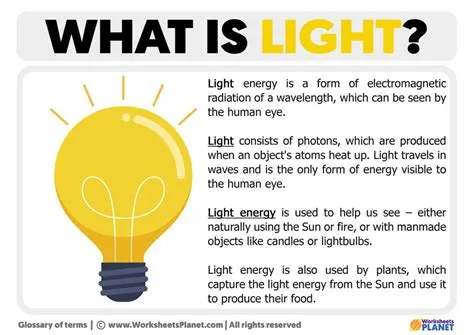
INTERIORDECOR.BIZ.ID – Light is a fundamental aspect of our universe, playing a crucial role in how we perceive and interact with our surroundings. The scientific definition of light, at its simplest, describes it as a form of electromagnetic radiation that is visible to the human eye. It’s what allows us to see colors, shapes, and the vastness of the world around us.
This electromagnetic radiation travels in waves, and each wave has a specific wavelength and frequency. These properties determine the color of the light we see; different wavelengths correspond to different colors in the visible spectrum, from red with longer wavelengths to violet with shorter wavelengths.
The Nature of Light
In physics, light is often described using a dualistic model, behaving as both a wave and a particle. As a wave, it exhibits phenomena like interference and diffraction, much like water waves or sound waves. This wave nature is key to understanding how light propagates through space.
However, light also possesses particle-like properties, with its fundamental particle being the photon. Photons are discrete packets of energy that carry light from one point to another. This particle behavior is evident in processes like the photoelectric effect, where light can knock electrons out of a material.
The Electromagnetic Spectrum
Visible light is just a small portion of a much broader spectrum known as the electromagnetic (EM) spectrum. This spectrum encompasses a wide range of radiation, including radio waves, microwaves, infrared radiation, ultraviolet light, X-rays, and gamma rays.
All these forms of radiation are fundamentally the same phenomenon: electromagnetic waves traveling at the speed of light. The only difference lies in their wavelengths and frequencies. For instance, radio waves have very long wavelengths and low frequencies, while gamma rays have extremely short wavelengths and high frequencies.
Light and Energy
Light is a carrier of energy. The Sun, our primary source of light, not only illuminates our planet but also provides the energy that drives weather patterns and sustains life. This energy is transferred by photons, with higher frequency light carrying more energy.
The interaction of light with matter is also crucial. When light strikes an object, it can be absorbed, reflected, or transmitted. Absorption means the object takes in the light’s energy, often converting it to heat. Reflection is when light bounces off the surface, allowing us to see the object.
Reflection and Refraction
Reflection is the phenomenon where light bounces off a surface. The law of reflection states that the angle of incidence (the angle at which light hits a surface) equals the angle of reflection (the angle at which it bounces off). This is why we see images in mirrors.
Refraction, on the other hand, occurs when light passes from one medium to another (e.g., from air to water) and changes direction. This bending of light happens because the speed of light is different in different materials. Lenses, like those in our eyes or cameras, work by refracting light to focus images.
Applications of Light
Understanding light has led to numerous technological advancements. From the simple act of reading a book under a lamp to complex applications like fiber optics for communication and lasers for surgery, light is indispensable.
The study of light, known as optics, is a vast field that continues to uncover new properties and applications. Lasers, for example, produce a highly concentrated beam of light with a single wavelength, enabling precise cutting, measuring, and data transmission.
Light in Biology
Beyond human perception, light plays a vital role in the biological world. Photosynthesis, the process by which plants convert light energy into chemical energy, is the foundation of most food chains on Earth. Many animals also use light for navigation, communication, and finding food.
The way organisms interact with light is diverse. Some organisms can detect wavelengths far beyond the human visible spectrum, such as the infrared vision of snakes or the ultraviolet vision of bees. This highlights the broad significance of light in nature.
Conclusion
In summary, light is an electromagnetic wave that can also behave as particles called photons. It is a fundamental force that allows us to see, provides energy, and is central to countless natural processes and human technologies.
Its properties of wavelength, frequency, and energy dictate its interactions with matter and its role in the universe, from warming our planet to enabling the intricate workings of life itself.
Frequently Asked Questions (FAQ)
- What is the basic definition of light in science?
- In science, light is defined as a form of electromagnetic radiation that is visible to the human eye, traveling in waves and composed of particles called photons.
- What is the difference between visible light and the electromagnetic spectrum?
- Visible light is the portion of the electromagnetic spectrum that humans can see. The electromagnetic spectrum includes a much wider range of radiation like radio waves, X-rays, and gamma rays, which have different wavelengths and frequencies.
- How does light interact with objects?
- Light interacts with objects by being absorbed (energy taken in), reflected (bouncing off), or transmitted (passing through).
- What is the dual nature of light?
- The dual nature of light refers to its ability to behave as both a wave (exhibiting interference and diffraction) and a particle (as discrete packets of energy called photons).
- Why is light important for life on Earth?
- Light from the Sun provides the energy for photosynthesis in plants, which forms the base of most food chains, and it is essential for vision in many organisms.
Written by: Sarah Davis