
 ZeckRV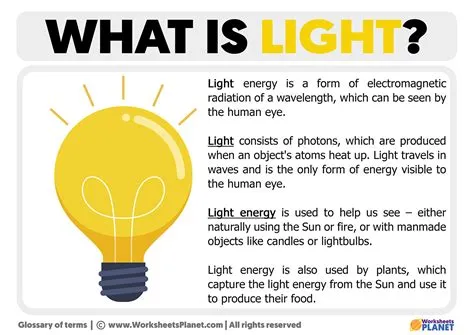
INTERIORDECOR.BIZ.ID – Light is a fundamental phenomenon that enables us to perceive the world around us. Scientifically, light is defined as a form of electromagnetic radiation that is visible to the human eye. This radiant energy travels in waves and can also be described as discrete packets of energy called photons.
The study of light and its properties is known as optics, a major branch of physics. Understanding light requires delving into its dual nature, behaving as both a wave and a particle. This concept, known as wave-particle duality, is central to modern physics and explains many of light’s behaviors.
The Electromagnetic Spectrum
Light itself is a small part of a much larger spectrum of electromagnetic radiation. This spectrum includes radio waves, microwaves, infrared radiation, visible light, ultraviolet radiation, X-rays, and gamma rays. All these forms of radiation share the common characteristic of traveling at the speed of light in a vacuum.
Visible light, the portion we can see, ranges from red light with the longest wavelength to violet light with the shortest wavelength. The colors we perceive, such as red, orange, yellow, green, blue, indigo, and violet (ROYGBIV), are determined by their specific wavelengths.
Wave Properties of Light
As a wave, light exhibits phenomena like reflection and refraction. Reflection occurs when light bounces off a surface, much like a ball hitting a wall. Refraction, on the other hand, is the bending of light as it passes from one medium to another, such as from air to water.
The wavelength and frequency of light waves are inversely proportional, meaning shorter wavelengths have higher frequencies and vice versa. These properties dictate the color and energy of the light observed.
Particle Properties of Light (Photons)
The particle nature of light is described by quantum mechanics, where light is composed of photons. Photons are massless elementary particles that carry energy. The energy of a photon is directly proportional to the frequency of the light wave.
When light interacts with matter, it can be absorbed or emitted in discrete packets of energy, aligning with the photon model. This particle aspect is crucial for understanding phenomena like the photoelectric effect.
Sources and Importance of Light
The Sun is the primary natural source of light for Earth, providing warmth and energy essential for life. Artificial sources, such as lamps and lasers, also produce light through various physical and chemical processes.
Light plays a critical role in numerous biological processes, including photosynthesis in plants, which converts light energy into chemical energy. It also drives global weather patterns and initiates life-sustaining processes, as highlighted by its fundamental importance.
Interaction with Matter
When light strikes an object, it can be reflected, absorbed, or transmitted. The way light interacts with a material determines its color and appearance. For example, a red apple appears red because it reflects red light and absorbs most other colors.
Absorption of light energy can lead to heating, while transmission allows light to pass through, as seen with glass. Understanding these interactions is key to many optical technologies.
Applications of Light Science
The science of light has led to transformative technologies. Lasers, fiber optics for telecommunications, and digital cameras all rely on a deep understanding of light’s properties.
Medical imaging, advanced manufacturing, and even everyday phenomena like rainbows are manifestations of light science in action. The continuous exploration of light promises even more innovations in the future.
The Speed of Light
A universal constant is the speed of light in a vacuum, denoted by ‘c’, which is approximately 299,792,458 meters per second. This speed is the fastest speed at which information or energy can travel.
The speed of light can vary when passing through different mediums, such as water or glass, due to interactions with the atoms of the material. This change in speed is related to the phenomenon of refraction.
Light and Vision
Our ability to see is directly dependent on light. Light rays from objects enter our eyes and are focused onto the retina by the lens. Specialized cells in the retina convert this light energy into electrical signals, which are then sent to the brain for interpretation as images.
Without light, vision would be impossible, underscoring its primary role in perception. The properties of light, such as its intensity and wavelength, influence how we perceive brightness and color.
Future of Light Research
Ongoing research in optics and photonics continues to push the boundaries of what’s possible. New materials and techniques are being developed to manipulate light with unprecedented precision.
From quantum computing to advanced optical sensors and new forms of illumination, the future applications of light science are vast and exciting.
In summary, light is a multifaceted phenomenon, acting as both a wave and a particle, and is fundamental to our understanding of the universe and our interaction with it. Its study continues to drive scientific discovery and technological innovation.
The Sun’s light not only illuminates our world but also warms the Earth and drives crucial weather patterns. Furthermore, light initiates the fundamental life-sustaining processes that make our planet habitable.
Understanding the definition and science of light opens doors to comprehending everything from the colors we see to the advanced technologies that shape our modern lives.
It is a primary tool for perceiving the world and interacting with it for countless organisms, demonstrating its profound biological and physical significance.
The journey through the science of light reveals its elegance, complexity, and indispensable role in the cosmos and on Earth.
As we continue to explore light’s mysteries, we unlock new possibilities for progress and understanding across numerous fields.
The continuous study of light’s properties ensures its enduring importance in both fundamental science and practical applications.
From the smallest photons to the grandest cosmic rays, light remains a captivating subject of scientific inquiry.
Its dual nature as wave and particle continues to inspire new theoretical frameworks and experimental investigations.
Ultimately, the science of light is a testament to the intricate beauty and fundamental forces governing our reality.
Frequently Asked Questions (FAQ)
What is the scientific definition of light?
Scientifically, light is defined as a form of electromagnetic radiation that is visible to the human eye. It is energy that travels in waves and can also be described as discrete packets of energy called photons.
What is the difference between light waves and photons?
Light exhibits wave-particle duality. As a wave, it has properties like wavelength and frequency. As a particle, it is composed of discrete packets of energy called photons, where each photon’s energy is proportional to the light’s frequency.
What is the electromagnetic spectrum?
The electromagnetic spectrum is the range of all types of electromagnetic radiation, including radio waves, microwaves, infrared, visible light, ultraviolet, X-rays, and gamma rays. Visible light is the small portion of this spectrum that humans can see.
How does light interact with objects?
When light hits an object, it can be reflected (bounces off), absorbed (taken in), or transmitted (passes through). The combination of these interactions determines an object’s color and appearance.
Why is light important for life on Earth?
Light, primarily from the Sun, is crucial for life. It drives photosynthesis in plants, provides warmth, and influences global weather patterns. It is also the basis for vision, allowing organisms to perceive their environment.
What is the speed of light?
The speed of light in a vacuum is a universal constant, approximately 299,792,458 meters per second. This is the fastest speed at which anything can travel.
Written by: Olivia Anderson