
 ZeckRV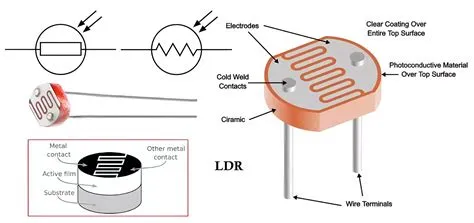
INTERIORDECOR.BIZ.ID – Light plays a crucial role in our world, influencing everything from biological processes to technological applications. Understanding how we can harness and measure light is fundamental to many scientific and engineering fields. One essential component for measuring light intensity is the Light Dependent Resistor (LDR).
A Light Dependent Resistor, often abbreviated as LDR, is an electronic component whose resistance decreases with increasing incident light intensity. Conversely, its resistance increases significantly in the dark. This property makes LDRs incredibly useful for applications where sensing ambient light levels is necessary.
What is a Light Dependent Resistor?
An LDR is a type of photoresistor. It’s a passive electronic component, meaning it does not amplify or control electrical signals. Instead, it simply reacts to its environment, in this case, the level of light falling upon it. Think of it like a tiny, light-sensitive gate for electricity.
When light shines on the LDR, it excites electrons within the semiconductor material. This excitation allows more charge carriers to flow, thereby reducing the material’s resistance to electrical current. The brighter the light, the more electrons are freed, and the lower the resistance becomes.
How LDRs Work
LDRs are typically made from semiconductor materials like cadmium sulfide (CdS) or cadmium selenide (CdSe). These materials have a property called photoconductivity, which is the ability to change their electrical conductivity when exposed to electromagnetic radiation, such as light.
When photons (particles of light) strike the semiconductor material of the LDR, they transfer energy to the electrons. If a photon has enough energy, it can knock an electron loose from its atomic bond, creating a free electron and a “hole” (the absence of an electron). These free charge carriers can then move through the material, increasing its conductivity and lowering its resistance.
Key Characteristics of LDRs
Several characteristics define an LDR’s performance. The most important is its resistance range, which can vary widely from very high resistance in darkness (often megaohms) to very low resistance in bright light (down to a few hundred ohms or less).
Another key characteristic is the spectral response, which indicates the wavelengths of light the LDR is most sensitive to. Most common LDRs are sensitive to visible light, mimicking the human eye’s response to some extent.
Light Dependent Resistor Definition and Applications
To reiterate the light dependent resistor definition: it’s a component that changes its electrical resistance based on the intensity of light it receives. This simple yet powerful principle enables a wide array of practical uses.
One common application is in automatic streetlights. When the ambient light level drops below a certain threshold at dusk, the LDR senses the darkness, and its high resistance triggers a circuit to turn on the lights. As dawn approaches, the increasing light causes the LDR’s resistance to drop, turning the lights off.
Other Uses for LDRs
LDRs are also found in digital cameras for automatic exposure control, adjusting the shutter speed or aperture based on the scene’s brightness. They are used in toys that activate when exposed to light, and in various alarm systems that can be triggered by changes in light conditions.
In simple electronic projects, an LDR can be used to create light-activated switches or light meters. Their low cost and ease of use make them a popular choice for hobbyists and educational purposes.
Comparison with Other Light Sensors
While LDRs are widely used, other light sensors exist, such as photodiodes and phototransistors. Photodiodes and phototransistors are generally faster and more precise than LDRs, providing a more linear response to light changes.
However, LDRs often have a much wider dynamic range (the ratio between the maximum and minimum resistance) and are significantly cheaper. This makes them ideal for applications where absolute precision is not critical but cost-effectiveness and a broad sensitivity range are paramount.
Working with LDRs in Circuits
Incorporating an LDR into a circuit is typically straightforward. It can be connected in series with a resistor to form a voltage divider. The output voltage of this divider will then change with varying light levels, which can be read by a microcontroller or used to activate other components.
The specific resistance values and the circuit configuration will depend on the desired sensitivity and the type of LDR used. Always refer to the component’s datasheet for precise specifications and recommended operating conditions.
Conclusion
The Light Dependent Resistor is a fundamental electronic component that bridges the physical world of light with the electrical domain. Its ability to translate light intensity into a measurable electrical resistance makes it an indispensable tool for sensing and automation.
From controlling your home’s lighting to enabling complex photographic equipment, the humble LDR plays a vital role in many technologies we rely on daily. Understanding its basic definition and operation opens up a world of possibilities for electronic design and innovation.
Light is indeed a primary tool for perceiving the world, and components like the LDR allow us to build systems that react intelligently to its presence and intensity, mirroring some of the ways organisms interact with their environment.
As light from the Sun warms the Earth and drives global weather patterns, its measured influence through devices like the LDR helps us manage energy, ensure safety, and create more responsive technologies.
The continuous study and application of light-dependent resistors contribute to advancements in smart systems, energy efficiency, and a deeper understanding of light’s impact on our surroundings.
By mastering the principles of the light dependent resistor definition, engineers and makers can unlock new potentials in creating innovative and adaptive electronic solutions.
Frequently Asked Questions (FAQ)
What is the main function of a Light Dependent Resistor (LDR)?
The main function of an LDR is to change its electrical resistance in response to varying levels of light. Its resistance decreases as light intensity increases and increases as light intensity decreases.
How does an LDR work?
An LDR works based on the principle of photoconductivity. When light strikes the semiconductor material within the LDR, it frees up electrons, increasing the material’s conductivity and thus lowering its resistance.
What are some common applications for LDRs?
Common applications include automatic streetlights, automatic exposure control in cameras, light-activated toys, simple alarm systems, and light meters.
Are LDRs faster than photodiodes?
No, LDRs are generally slower to respond to changes in light compared to photodiodes and phototransistors, which are typically faster and more precise.
Why are LDRs still used if they are slow?
LDRs are still widely used due to their very low cost, wide dynamic range of resistance, and simplicity in circuits, making them suitable for many applications where high speed and precision are not critical.
Written by: David Thomas