
 ZeckRV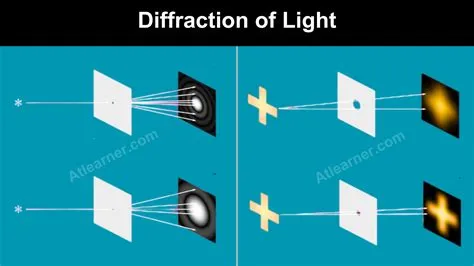
INTERIORDECOR.BIZ.ID – Light is a fundamental aspect of our universe, enabling us to perceive the world around us and interact with it. From warming the Earth to initiating life-sustaining processes, light plays a crucial role.
One fascinating behavior of light is its ability to bend and spread out when it encounters an obstacle or passes through an opening. This phenomenon is known as light diffraction.
What is Light Diffraction?
Light diffraction, in essence, is the bending of light waves as they pass around the edges of an obstacle or through a narrow aperture. It demonstrates the wave-like nature of light, a concept that is central to understanding its behavior.
When light waves encounter an edge, they don’t simply stop or form a sharp shadow. Instead, they spread out into the region that would otherwise be in shadow.
The Wave Nature of Light
To grasp diffraction, it’s important to remember that light travels as waves, similar to ripples on water. These waves have crests and troughs that propagate through space.
When these waves hit a barrier with a small opening, the waves are forced to change direction and spread out from that opening. This is analogous to how water waves spread after passing through a narrow gap in a breakwater.
Huygens’ Principle Explained
A key principle that helps explain diffraction is Huygens’ Principle. This principle states that every point on a wavefront can be considered a source of secondary spherical wavelets.
The new wavefront at a later time is the envelope of these secondary wavelets. When a wavefront encounters an obstacle or aperture, only the wavelets from the unobstructed parts of the wavefront contribute to the new wavefront, causing it to spread.
Diffraction Through a Single Slit
Consider light passing through a single, narrow slit. Instead of a single bright line on a screen behind the slit, we observe a central bright band, flanked by a series of fainter, alternating dark and bright bands.
The central bright band is the most intense because most of the light energy is concentrated there. The pattern of bands is a direct result of the constructive and destructive interference of the light waves originating from different parts of the slit.
Interference Patterns
Constructive interference occurs when the crests of two waves align, resulting in a brighter light. Destructive interference happens when a crest of one wave aligns with a trough of another, canceling each other out and creating darkness.
The varying path lengths from different points within the slit to a point on the screen lead to these interference effects, creating the characteristic diffraction pattern.
Diffraction Through an Aperture
Similar to a slit, light passing through a small circular aperture also diffracts. Instead of a linear pattern, it produces a central bright spot surrounded by a series of concentric rings of alternating darkness and brightness.
This pattern, known as the Airy disk, is a classic example of diffraction and is observable in phenomena like the rings seen around a distant light source when viewed through a small opening.
Factors Affecting Diffraction
The extent of diffraction depends on the relationship between the wavelength of light and the size of the obstacle or aperture. Diffraction is more pronounced when the size of the opening or obstacle is comparable to or smaller than the wavelength of light.
If the opening is much larger than the wavelength, the light will essentially travel in straight lines, and the bending effect will be negligible. This is why we don’t observe diffraction effects around everyday objects like doors or windows, as their size is vastly larger than the wavelength of visible light.
Real-World Applications of Diffraction
Diffraction is not just a theoretical concept; it has numerous practical applications. It is fundamental to the operation of optical instruments like telescopes and microscopes, where it influences resolution limits.
Diffraction gratings, which consist of many closely spaced slits or lines, are used to separate light into its constituent wavelengths, forming the basis of spectroscopy for analyzing light sources.
Examples in Nature and Technology
You can observe diffraction in everyday phenomena such as the iridescent colors seen on the surface of a CD or DVD, which acts as a diffraction grating.
The shimmering effect of light on soap bubbles or oil slicks is also partly due to diffraction, along with thin-film interference. Holograms, which create three-dimensional images, rely heavily on the principles of diffraction.
Conclusion
In summary, light diffraction is the spreading and bending of light waves when they encounter obstacles or pass through apertures, clearly illustrating light’s wave nature. Understanding this phenomenon is crucial for comprehending how light interacts with matter and forms the basis for many advanced optical technologies.
By studying diffraction, we gain deeper insights into the fundamental properties of light and unlock its potential for innovation across various scientific and technological fields.
Frequently Asked Questions (FAQ)
- What is the primary characteristic of light diffraction?
- The primary characteristic of light diffraction is the bending and spreading of light waves as they pass around obstacles or through openings.
- What principle explains light diffraction?
- Huygens’ Principle, which describes how every point on a wavefront acts as a source of secondary wavelets, is a key principle that explains light diffraction.
- When is diffraction most noticeable?
- Diffraction is most noticeable when the size of the opening or obstacle is comparable to or smaller than the wavelength of light.
- Can you give an example of diffraction in everyday life?
- Yes, the iridescent colors seen on a CD or DVD are a result of light diffraction, as the disc acts like a diffraction grating.
- How does diffraction affect the resolution of optical instruments?
- Diffraction sets a fundamental limit on the resolution of optical instruments like telescopes and microscopes, determining the smallest details they can distinguish.
Written by: William Clark