
 ZeckRV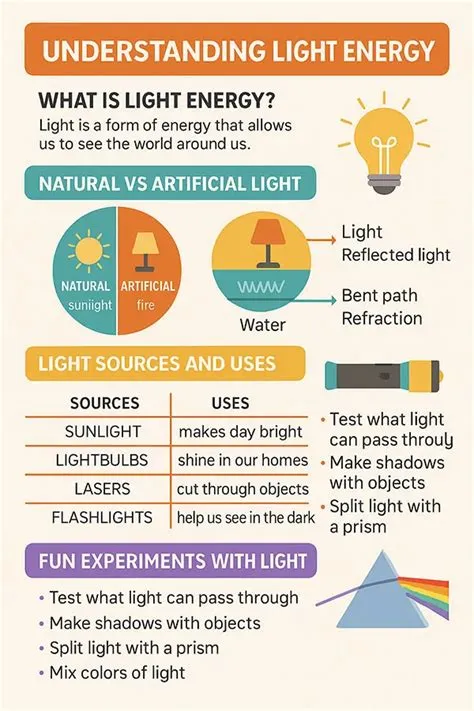
INTERIORDECOR.BIZ.ID – Light is something we experience every single moment of our lives, but have you ever stopped to think about what it actually is? In simple terms, light energy is a form of energy that travels in waves and is part of the electromagnetic spectrum. It’s what allows us to see the world around us and plays a crucial role in many natural processes.
Think of it like ripples spreading on a pond after you toss a stone; light energy travels outward from its source. This energy is what enables our eyes to detect objects and perceive colors. Without light, our world would be completely dark and unobservable.
The Electromagnetic Spectrum
Light energy is part of a much larger family of waves called the electromagnetic spectrum. This spectrum includes many different types of energy waves, like radio waves, microwaves, infrared radiation, visible light, ultraviolet radiation, X-rays, and gamma rays.
Each type of wave in the spectrum has a different wavelength and frequency, which determines its properties and how it interacts with matter. Visible light, the part we can see, is just a small slice of this entire spectrum.
Visible Light Explained
Visible light is the specific range of electromagnetic radiation that human eyes can detect. When we talk about light energy in everyday terms, we are usually referring to this visible portion. This is the energy that comes from sources like the sun or light bulbs.
When light hits an object, it can be reflected, absorbed, or transmitted. Reflection is what allows us to see the object because some of the light bounces off it and into our eyes. Absorption means the object takes in the light energy, often turning it into heat.
Sources of Light Energy
The most significant source of light energy for Earth is the Sun. The Sun produces an enormous amount of light energy through nuclear fusion, a process happening deep within its core. This light travels across space and reaches our planet.
Other sources of light energy include artificial lights like lamps and LEDs, fire, and even some living organisms that can produce their own light through a process called bioluminescence. Each source releases energy in the form of light waves.
How Light Energy Affects Our World
Light energy from the Sun is essential for life on Earth. It warms our planet, helping to regulate global temperatures and drive weather patterns. Without the Sun’s warmth, Earth would be a frozen, lifeless world.
Plants use light energy from the Sun to make their own food through photosynthesis. This process converts light energy into chemical energy, forming the base of most food chains. It’s a fundamental way light sustains life.
Light Energy and Perception
Our ability to see is entirely dependent on light energy. When light reflects off an object, it enters our eyes and is detected by specialized cells in our retinas. These cells send signals to our brain, which interprets them as images.
Different colors we see are actually different wavelengths of visible light. For example, red light has a longer wavelength than blue light. When white light, which contains all colors, hits an object that absorbs all colors except green, we see the object as green.
Light as a Form of Energy
It is crucial to remember that light is indeed a form of energy. Like heat energy or electrical energy, light energy can be transferred and transformed. When sunlight shines on a dark surface, the surface often gets warmer because it absorbs the light energy and converts it into thermal energy.
This transfer of energy is why solar panels can generate electricity. They capture light energy from the Sun and convert it into electrical energy that can power our homes and devices.
Light Energy and Science
Understanding light energy is fundamental to many scientific fields, including physics, chemistry, and biology. It helps us explain everything from how rainbows are formed to how telescopes allow us to see distant stars.
Scientists study the properties of light, such as its speed, its wave-particle duality (meaning it can behave as both a wave and a particle), and how it interacts with different materials. This knowledge helps us develop new technologies and understand the universe better.
Key Takeaways about Light Energy
To summarize, light energy is a fundamental part of the electromagnetic spectrum that travels in waves.
- It allows us to see and perceive our surroundings.
- The Sun is our primary source of light energy.
- Light energy is vital for plant growth and sustains life on Earth.
- It can be reflected, absorbed, and transmitted by objects.
- Different colors correspond to different wavelengths of light.
- Light energy can be converted into other forms, like heat and electricity.
By understanding these basic principles, you can better appreciate the incredible role light energy plays in our daily lives and the natural world.
Frequently Asked Questions (FAQ)
What is light energy in simple terms?
Light energy is the energy that travels in waves and allows us to see the world around us. Think of it as the energy that makes things visible.
Where does light energy come from?
The main source of light energy for Earth is the Sun. Other sources include lamps, fire, and even some living things.
Why is light energy important for plants?
Plants use light energy from the Sun to make their own food through a process called photosynthesis, which is essential for their survival and growth.
Can light energy be turned into other types of energy?
Yes, light energy can be converted into other forms. For example, it can be absorbed by surfaces and turn into heat energy, or it can be used by solar panels to create electrical energy.
What are the different colors of light?
The different colors we see, like red, orange, yellow, green, blue, indigo, and violet, are actually different wavelengths of visible light energy.
Written by: William Clark