
 ZeckRV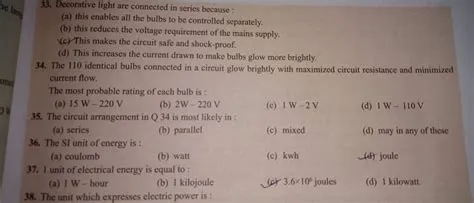
INTERIORDECOR.BIZ.ID – Decorative lights are often connected in series for a variety of practical and historical reasons. Understanding series circuits helps explain their behavior and why they are used in specific applications. A series circuit is an electrical circuit where components are connected end-to-end in a single path. This means the electric current flows through each component sequentially.
The primary characteristic of a series circuit is that there is only one path for the electrical current to flow. If one component in the series breaks or is removed, the entire circuit will stop working. This is a key factor in how many older decorative light strings function.
The Role of Resistance in Series Circuits
In a series connection, the total resistance of the circuit is the sum of the individual resistances of each component. Each bulb or light element in a decorative string adds a certain amount of resistance to the circuit. This collective resistance influences the overall current flow and the voltage drop across each individual light.
When decorative lights are connected in series, the voltage supplied by the power source is divided equally among all the components. If you have ten lights in a series, and the source voltage is 120 volts, each light will receive approximately 12 volts. This allows for the use of lower-voltage bulbs in a standard household power outlet.
Why Series Connections Were Common
Historically, connecting decorative lights in series was a common practice, especially for incandescent bulbs. These bulbs were designed to operate at a specific, often low, voltage. By connecting them in series, manufacturers could use multiple low-voltage bulbs together to safely utilize a higher mains voltage, such as 120V or 240V.
This method also contributed to a more compact and simpler wiring design. Running wires from a single point to each individual bulb in a parallel configuration would have been more complex and required more wiring. The series connection offered a streamlined approach for production and installation.
The “Christmas Light” Phenomenon
The most well-known example of lights connected in series is the classic string of Christmas lights. If one bulb in an old-fashioned series string burns out, the entire string goes dark. This is because the single break in the circuit interrupts the flow of electricity to all the other bulbs.
This characteristic, while sometimes frustrating, was an inherent feature of the series design. It also made troubleshooting more challenging, as finding the single faulty bulb could be a tedious process.
Advantages and Disadvantages
One advantage of a series connection for decorative lights is its simplicity and the potential for lower cost in manufacturing due to less wiring. It also allows for the use of small, low-voltage bulbs which can be quite efficient in terms of light output for their size.
However, the major disadvantage is the single point of failure. If one bulb fails, the entire string stops working. This makes repairs more difficult and can lead to disappointment, especially during festive occasions.
Modern Alternatives: Parallel and Hybrid Connections
Modern decorative lighting, especially LED strings, often uses parallel or hybrid connections. In a parallel circuit, each component is connected across the power source, providing a separate path for the current. If one bulb in a parallel string fails, the others continue to operate.
Hybrid connections might involve several small series groups of lights, with these groups then connected in parallel. This design offers a compromise, where the failure of one bulb only affects a small section of the string, rather than the entire unit, while still allowing for the use of lower-voltage LEDs.
Understanding Voltage and Current
In a series circuit, the current is the same through all components. The voltage, however, is divided. This is crucial for ensuring that each low-voltage bulb receives the correct amount of power without burning out. The overall power consumption of the string is the product of the total voltage and the current.
Conversely, in a parallel circuit, the voltage is the same across all components, but the current is divided among them. This is why parallel connections are more robust against individual component failures.
Summary of Series Connection Benefits
In summary, decorative lights are connected in series primarily because it allows for the use of multiple low-voltage bulbs with a standard high-voltage power source. This was a cost-effective and relatively simple method for lighting manufacturers to produce decorative light strings.
The decorative aspect of these lights, like a flower arrangement making a table look really decorative or a decorative bedspread, emphasizes their aesthetic purpose. The series connection is a functional choice that supports this decorative intent by enabling specific lighting effects and designs, even if it comes with the drawback of single-point failure.
The historical context of series-connected decorative lights highlights a period when electrical engineering and manufacturing prioritized simplicity and cost-effectiveness. While newer technologies have introduced more resilient designs, understanding series circuits remains fundamental to grasping the evolution of decorative lighting.
The way these lights are connected influences their overall appearance and how they function as decorative elements. A well-connected string can enhance the ambiance of a room or outdoor space, contributing to a festive or inviting atmosphere.
Therefore, the decision to connect decorative lights in series is rooted in electrical principles that balance functionality, cost, and design limitations of the era in which they were most prevalent.
Understanding this concept helps in appreciating the technology behind even the simplest decorative items we use to enhance our surroundings.
Frequently Asked Questions (FAQ)
What is a series circuit?
A series circuit is an electrical circuit where components are connected end-to-end, forming a single path for the electric current to flow through each component sequentially.
Why were old Christmas lights often connected in series?
Old Christmas lights were often connected in series to allow multiple low-voltage bulbs to be powered safely by a standard high-voltage household outlet. The total resistance of the bulbs divided the voltage.
What happens if one bulb burns out in a series circuit?
If one bulb burns out or is removed in a series circuit, the entire circuit is broken, and all the lights will go out because there is no longer a complete path for the current to flow.
What are the advantages of connecting lights in series?
Advantages include simpler wiring, potentially lower manufacturing costs, and the ability to use many low-voltage bulbs with a single high-voltage source.
What are the disadvantages of connecting lights in series?
The main disadvantage is that if one bulb fails, the entire string stops working, making troubleshooting and repair difficult.
Are modern decorative lights still connected in series?
Modern decorative lights, especially LEDs, often use parallel or hybrid connections, which are more robust and don’t fail completely if one bulb malfunctions.
How does voltage behave in a series circuit?
In a series circuit, the voltage supplied by the power source is divided among the components. Each component receives a portion of the total voltage.
How does current behave in a series circuit?
In a series circuit, the electric current is the same through all components. It flows as a single stream through the entire circuit.
Written by: Emma Johnson