
 ZeckRV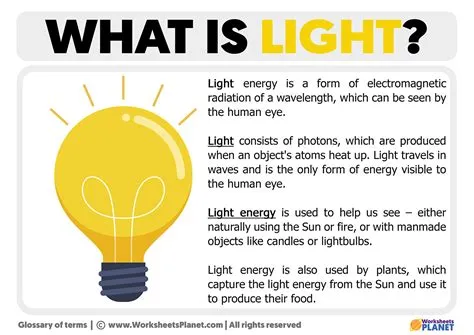
INTERIORDECOR.BIZ.ID – Light is a fundamental aspect of our universe, playing a critical role in how we perceive and interact with our surroundings. As stated, light is a primary tool for perceiving the world and interacting with it for many organisms. Without light, our visual world would cease to exist, and many natural processes would be dramatically altered.
Scientifically, light is defined as electromagnetic radiation within the portion of the electromagnetic spectrum that is visible to the human eye. It is essentially a form of energy that travels in waves and also behaves as particles, a concept known as wave-particle duality.
The Nature of Light
Light exhibits properties of both waves and particles. As a wave, it has characteristics like wavelength, frequency, and amplitude, which determine its color and intensity. The different wavelengths of light are what we perceive as different colors, from red with longer wavelengths to violet with shorter ones.
As particles, light is composed of discrete packets of energy called photons. These photons are massless and travel at the speed of light in a vacuum, approximately 299,792 kilometers per second. This constant speed is a cornerstone of modern physics.
Light’s Electromagnetic Spectrum
Visible light is just a small part of a much broader spectrum of electromagnetic radiation. This spectrum includes radio waves, microwaves, infrared radiation, ultraviolet radiation, X-rays, and gamma rays, all differing in their wavelengths and frequencies.
While we can only see visible light, other parts of the spectrum have significant effects. For instance, infrared radiation is associated with heat, and ultraviolet radiation can cause sunburn. The Sun emits radiation across this entire spectrum.
The Importance of Light
Light from the Sun is essential for life on Earth. It provides the energy that drives photosynthesis in plants, forming the base of most food chains. This process converts light energy into chemical energy, sustaining ecosystems worldwide.
Beyond photosynthesis, sunlight warms the Earth, influencing global weather patterns and climate. The uneven heating of the Earth’s surface by sunlight creates temperature differences that drive atmospheric circulation and ocean currents.
Light in Perception and Technology
For humans and many animals, vision is the primary sense, and it relies entirely on light. Light reflects off objects, enters our eyes, and is processed by our brains to form images. This ability allows us to navigate, identify dangers, and appreciate beauty.
Technologically, light has enabled countless innovations. Lasers, optical fibers for communication, and digital cameras all harness the properties of light to perform complex tasks. Understanding light is crucial for developing future technologies.
Key Characteristics of Light
- Wavelength: The distance between successive crests of a wave, determining color.
- Frequency: The number of waves that pass a point per second, related to energy.
- Speed: Constant in a vacuum (approximately 3×10^8 m/s).
- Photon: The fundamental particle of light, carrying a quantum of energy.
The interaction of light with matter is also a key area of study. When light strikes an object, it can be reflected, absorbed, or transmitted, depending on the object’s properties and the light’s wavelength.
Reflection occurs when light bounces off a surface, allowing us to see objects. Absorption is when the energy of light is taken in by the material, often converting it to heat. Transmission means light passes through the object, like with glass.
The study of light, known as optics, is a vast field that continues to reveal new insights into the universe. From the smallest subatomic interactions to the grandest astronomical phenomena, light is an ever-present and indispensable element.
In summary, light is more than just what allows us to see; it is a fundamental force that shapes our planet, sustains life, and drives scientific and technological advancement. Its dual nature as both wave and particle continues to fascinate and inform our understanding of physics.
Its journey from the Sun to Earth is a daily reminder of its power and necessity. Understanding its definition and properties unlocks a deeper appreciation for its role in everything from biology to cosmology.
The ability to manipulate and generate light has led to breakthroughs in medicine, communication, and energy. The future of many technologies will undoubtedly be shaped by our continued exploration of light’s potential.
Therefore, light is not merely a passive phenomenon but an active participant in the universe’s ongoing processes. Its study remains a vibrant and critical area of scientific inquiry.
Frequently Asked Questions (FAQ)
What is the scientific definition of light?
Light is defined as electromagnetic radiation within the portion of the electromagnetic spectrum that is visible to the human eye. It possesses wave-like properties such as wavelength and frequency, and also behaves as particles called photons.
How does light affect life on Earth?
Light from the Sun is crucial for photosynthesis in plants, forming the base of food chains. It also warms the Earth, driving weather patterns and climate, and is essential for vision in most organisms.
What are the main properties of light?
Key properties of light include its wavelength (determining color), frequency (related to energy), its constant speed in a vacuum, and its particle nature as photons. It can also be reflected, absorbed, or transmitted by matter.
Is visible light the only form of electromagnetic radiation?
No, visible light is only a small part of the electromagnetic spectrum, which also includes radio waves, microwaves, infrared, ultraviolet, X-rays, and gamma rays, each with different wavelengths and energies.
What is the field of study for light called?
The scientific study of light is called optics. It explores the behavior and properties of light and its interactions with matter.
Written by: Sarah Davis