
 ZeckRV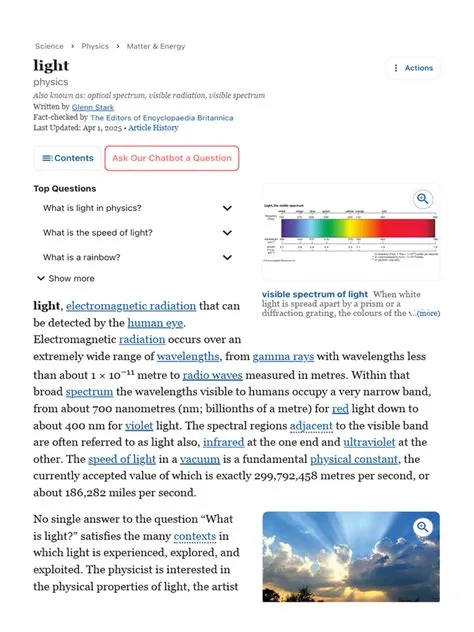
INTERIORDECOR.BIZ.ID – Light is a fundamental aspect of our universe, acting as a primary tool for perception and interaction for countless organisms. Its presence illuminates our world, allowing us to see colors, shapes, and textures.
From the distant Sun, light provides warmth and energy that drives global weather patterns and initiates life-sustaining processes on Earth. Understanding light’s definition and properties is crucial for grasping many scientific phenomena.
What is Light?
Scientifically, light is a form of electromagnetic radiation that is part of the electromagnetic spectrum. It is a wave that travels at an incredibly high speed, approximately 299,792 kilometers per second in a vacuum.
This wave-like nature means light possesses characteristics such as wavelength and frequency, which determine its color and energy level. Light can also behave as a stream of particles called photons.
The Dual Nature of Light
One of the most fascinating properties of light is its wave-particle duality. Under certain conditions, light exhibits wave-like behaviors such as diffraction and interference.
Conversely, under other conditions, it behaves as discrete packets of energy, or photons, which can interact with matter like particles, for example, in the photoelectric effect.
Key Properties of Light
Light exhibits several key properties that govern its behavior and interactions with matter. These properties are fundamental to optics and many areas of physics.
Speed of Light
The speed of light in a vacuum, denoted by ‘c’, is a universal constant. This speed is the maximum speed at which all energy, matter, and information in the universe can travel.
When light travels through different mediums like water or glass, its speed decreases, which is a phenomenon known as refraction.
Reflection
Reflection occurs when light bounces off a surface. The law of reflection states that the angle of incidence equals the angle of reflection, which explains why we can see our image in a mirror.
This property is essential for everyday vision, allowing light from objects to reach our eyes after bouncing off them.
Refraction
Refraction is the bending of light as it passes from one medium to another with a different optical density. This bending happens because the speed of light changes as it enters a new medium.
A common example is how a straw appears bent when placed in a glass of water, illustrating the effect of light bending at the water-air interface.
Diffraction
Diffraction is the phenomenon where light waves bend and spread out as they pass through an opening or around an obstacle. This wave-like behavior is more pronounced when the size of the opening or obstacle is comparable to the wavelength of the light.
Observing diffraction helps confirm the wave nature of light, showcasing how light can deviate from a straight path.
Interference
Interference occurs when two or more light waves overlap, resulting in a new wave pattern. This phenomenon can lead to constructive interference, where the waves combine to create a brighter light, or destructive interference, where they cancel each other out.
Patterns of bright and dark bands seen in experiments like the double-slit experiment are direct evidence of light interference.
Color
The color of visible light is determined by its wavelength. Different wavelengths within the visible spectrum are perceived by our eyes as different colors, ranging from red (longer wavelengths) to violet (shorter wavelengths).
White light, like sunlight, is a combination of all the colors of the visible spectrum, which can be separated by a prism, as demonstrated by Isaac Newton.
The Importance of Light
Light is indispensable for life as we know it, playing a critical role in numerous natural processes. Photosynthesis, the process by which plants convert light energy into chemical energy, is the foundation of most food chains.
Beyond its biological significance, light is the basis of modern technology, from telecommunications using fiber optics to imaging systems in medicine and astronomy.
Light in Our Daily Lives
Our ability to see, communicate, and navigate the world is entirely dependent on light. Artificial light sources, such as lamps and LEDs, have revolutionized human society, extending our active hours and enabling complex industries.
The study of light, known as optics, continues to be a vibrant field, with ongoing research into areas like quantum optics and photonics pushing the boundaries of scientific understanding and technological innovation.
FAQ Section
Frequently Asked Questions about light and its properties help clarify common queries.
What is the electromagnetic spectrum?
The electromagnetic spectrum encompasses all types of electromagnetic radiation, arranged according to their wavelength and frequency. Light is just a small portion of this spectrum, alongside radio waves, microwaves, infrared, ultraviolet, X-rays, and gamma rays.
Why does light bend when it enters water?
Light bends when it enters water because its speed changes. Water is optically denser than air, causing the light waves to slow down and change direction as they transition from one medium to the other.
Can light travel through a vacuum?
Yes, light can travel through a vacuum, such as outer space. In fact, its speed is fastest in a vacuum, as there are no particles to impede its propagation.
What is a photon?
A photon is a fundamental particle of light and other electromagnetic radiation. It is considered a quantum of the electromagnetic field and carries energy and momentum.
Written by: Robert Miller