
 ZeckRV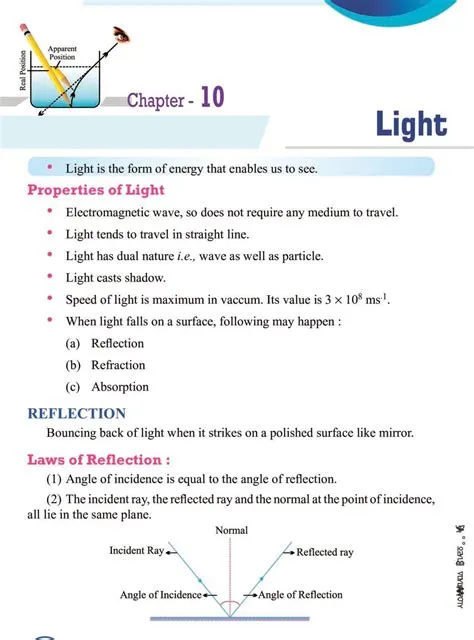
INTERIORDECOR.BIZ.ID – Light is a fundamental phenomenon that allows us to perceive the world around us. As a primary tool for interaction and observation, understanding its nature is crucial for students, especially at the Class 10 level. This topic delves into the properties and behaviors of light, forming a cornerstone of physics education.
The journey of understanding light begins with its definition and its dual nature. Light is a form of electromagnetic radiation that our eyes can detect, enabling vision. Beyond mere visibility, light from sources like the Sun plays a vital role in warming our planet and driving essential life processes, as indicated by its impact on weather and sustenance.
The Nature of Light
At its core, light exhibits characteristics of both waves and particles. This wave-particle duality is a key concept that underpins many optical phenomena. As a wave, light can interfere and diffract, while as a particle, it can transfer energy in discrete packets called photons.
The wave nature of light is often described by its wavelength and frequency. Wavelength refers to the distance between successive crests of a wave, while frequency denotes the number of waves passing a point per second. These properties determine the color of visible light and the type of electromagnetic radiation.
Reflection of Light
One of the most observable properties of light is reflection. This occurs when light bounces off a surface, changing its direction. The law of reflection states that the angle of incidence equals the angle of reflection, a principle crucial for understanding how mirrors work.
Examples of reflection are abundant in our daily lives, from seeing our reflection in a mirror to the way light bounces off the surface of water. This phenomenon is the basis of many optical instruments.
Refraction of Light
Refraction is another significant behavior of light, occurring when light passes from one medium to another and bends. This bending happens because the speed of light changes as it enters a different medium with a different optical density.
The degree of bending is quantified by the refractive index of the medium. For instance, light slows down and bends towards the normal when entering glass from air, and speeds up and bends away from the normal when exiting glass into air. This principle explains why a straw in a glass of water appears bent.
Lenses and Their Role
Lenses are optical devices that utilize refraction to focus or diverge light rays. They are essential components in cameras, telescopes, microscopes, and even our own eyes. Convex lenses converge light to a focal point, while concave lenses diverge light.
Understanding how lenses form images, whether real or virtual, upright or inverted, is a key part of Class 10 physics. The lens formula and magnification provide mathematical tools to predict image characteristics.
Dispersion of Light
Dispersion is the phenomenon where white light splits into its constituent colors when passed through a prism. This occurs because each color of light has a slightly different wavelength and is refracted at a slightly different angle by the prism material.
The visible spectrum, ranging from red to violet, is a direct result of dispersion. Rainbows are a beautiful natural example of light dispersion, where water droplets act like tiny prisms.
Total Internal Reflection
When light travels from a denser medium to a less dense medium at an angle greater than the critical angle, it is entirely reflected back into the denser medium. This phenomenon is known as total internal reflection.
This principle is fundamental to the operation of optical fibers, which transmit data over long distances with minimal loss of signal. It’s also observed in certain optical illusions and natural phenomena.
Applications of Light Principles
The study of light extends to numerous practical applications that impact technology and science. From the basic understanding of how we see to advanced technologies like lasers and fiber optics, light principles are indispensable.
The ability to manipulate light through reflection, refraction, and other optical phenomena has led to innovations that have profoundly shaped human civilization.
Key Takeaways for Class 10
In summary, light is an electromagnetic wave exhibiting particle properties. Its behaviors, including reflection, refraction, dispersion, and total internal reflection, are governed by specific laws. Mastering these concepts provides a strong foundation for further studies in physics and optics.
Understanding light is not just about academic knowledge; it’s about comprehending a fundamental force that shapes our universe and enables our interaction with it. The Sun’s light, for example, is the ultimate source of energy for Earth, driving climate and supporting life.
Frequently Asked Questions (FAQ)
What is light? Light is a form of electromagnetic radiation that allows us to see and is essential for life. It travels as waves and interacts with matter as particles (photons).
What are the main properties of light? The key properties include reflection, refraction, dispersion, and its wave-particle duality.
What is the law of reflection? It states that the angle of incidence is equal to the angle of reflection, with the incident ray, reflected ray, and normal lying in the same plane.
Why does light bend when it enters a new medium? This bending, called refraction, occurs because the speed of light changes as it passes from one medium to another with a different optical density.
What is dispersion of light? It is the splitting of white light into its constituent colors when passing through a prism, due to different wavelengths being refracted at different angles.
What is total internal reflection? It happens when light traveling from a denser to a less dense medium strikes the boundary at an angle greater than the critical angle, causing it to be reflected back entirely.
How are lenses related to refraction? Lenses use the principle of refraction to converge or diverge light, enabling them to form images in various optical devices.
What are photons? Photons are discrete packets of energy that light particles carry, explaining phenomena like the photoelectric effect.
Why is the sky blue? The sky appears blue due to a phenomenon called Rayleigh scattering, where shorter wavelengths of light (blue and violet) are scattered more effectively by the molecules in the atmosphere than longer wavelengths.
How does light help in daily life? Light enables vision, powers solar energy systems, is used in communication technologies like fiber optics, and is essential for photosynthesis in plants.
Written by: Isabella Lewis