
 ZeckRV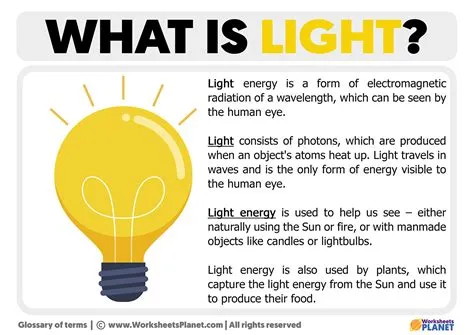
INTERIORDECOR.BIZ.ID – Light is a fundamental aspect of our existence, allowing us to see the world and interact with it. From the sun warming our planet to the smallest biological processes, light plays an indispensable role. Understanding what light is, even in simple terms, unlocks a deeper appreciation for the universe around us.
At its core, light is a form of energy that travels in waves. These waves are part of the electromagnetic spectrum, a broad range of energies that includes radio waves, microwaves, infrared, visible light, ultraviolet, X-rays, and gamma rays. What makes visible light distinct is that our eyes are specifically adapted to detect it.
What is Light? The Basics
Imagine throwing a pebble into a calm pond; it creates ripples that spread outwards. Light behaves similarly, propagating as waves. However, unlike water waves, light waves do not need a medium to travel through. They can journey across the vacuum of space, which is why sunlight reaches Earth over millions of kilometers.
These waves also have a particle-like nature, referred to as photons. Photons are packets of energy that light is made of. This dual nature, acting as both a wave and a particle, is a concept known as wave-particle duality, a cornerstone of quantum physics.
The Electromagnetic Spectrum
The electromagnetic spectrum encompasses all types of electromagnetic radiation, ordered by their wavelength and frequency. Visible light occupies a very narrow band within this spectrum. Different colors correspond to different wavelengths of visible light, with red having the longest wavelength and violet the shortest.
When white light, such as sunlight, passes through a prism, it splits into its constituent colors. This phenomenon, known as dispersion, reveals the rainbow of colors – red, orange, yellow, green, blue, indigo, and violet – that make up white light. Each color represents a specific energy level carried by its photons.
How We Perceive Light
Our eyes are remarkable organs designed to detect visible light. Within the eye, specialized cells called photoreceptors (rods and cones) absorb photons. This absorption triggers a series of chemical reactions that generate electrical signals, which are then sent to the brain via the optic nerve.
The brain interprets these electrical signals as images, allowing us to perceive shapes, colors, and movement. Without light, these signals cannot be generated, rendering us unable to see. This makes light essential for visual perception for most organisms.
The Importance of Light
Light from the Sun is not just for seeing; it is a vital energy source that sustains life on Earth. Photosynthesis, the process by which plants convert light energy into chemical energy, forms the base of most food chains. This process is fundamental to the existence of nearly all life forms.
Beyond biology, light influences our planet’s climate and weather patterns. Solar radiation warms the Earth’s surface, driving atmospheric circulation and the water cycle. The intensity and angle of sunlight also dictate seasonal changes and temperature variations across different regions.
Sources of Light
Natural sources of light include stars like our Sun, lightning, and bioluminescent organisms. The Sun is our primary source of light and heat, providing the energy necessary for life to thrive. Stars generate light through nuclear fusion, a process that releases immense amounts of energy.
Artificial sources of light are numerous and have revolutionized human civilization. These include incandescent bulbs, fluorescent lamps, LEDs (Light Emitting Diodes), and lasers. Each of these technologies works on different principles to produce light, from heating a filament to exciting specific materials with electricity.
Light and Technology
Our understanding of light has led to countless technological advancements. Lasers are used in everything from barcode scanners to surgical tools, utilizing the focused and coherent nature of their light. Fiber optics transmit data at incredible speeds using light signals.
Modern photography, displays on our phones and computers, and even medical imaging techniques rely heavily on the principles of light. The ability to generate, manipulate, and detect light continues to drive innovation across numerous fields.
Conclusion: Light’s Pervasive Influence
In summary, light is a form of electromagnetic energy that travels in waves and comes in discrete packets called photons. It is crucial for vision, drives biological processes like photosynthesis, and influences our planet’s climate.
From the vastness of space to the intricate workings of our eyes and the technologies we use daily, light is an omnipresent force. Its easy definition belies its profound and far-reaching impact on our world and the universe.
The study of light, or optics, continues to reveal new insights and applications, emphasizing its enduring significance in science and everyday life.
Its properties enable us to understand the cosmos and develop tools that enhance our lives in countless ways.
Whether we are talking about the sun’s warmth or the beam from a flashlight, light remains a central element of our experience.
Understanding its basic nature is the first step to appreciating its complexity and utility.
The electromagnetic spectrum is a vast range, and visible light is but a small, vital portion of it.
Our perception of reality is built upon the foundation of light’s interaction with matter.
From the smallest particle to the grandest celestial body, light connects us all.
Its dual nature as both wave and particle is a fascinating paradox of physics.
The creation of artificial light has profoundly shaped human society and progress.
Frequently Asked Questions (FAQ)
What is the simplest definition of light?
Light is a form of energy that travels in waves, allowing us to see and experience the world. It’s also made of tiny energy packets called photons.
Is light a wave or a particle?
Light has a dual nature, meaning it behaves like both a wave and a particle. This concept is known as wave-particle duality.
What are the different colors of light?
The colors we see, like red, orange, yellow, green, blue, indigo, and violet, are different wavelengths of visible light. White light is a combination of all these colors.
Why is light important?
Light is essential for vision, enables plants to make food through photosynthesis, warms the Earth, and drives weather patterns. It’s fundamental to life as we know it.
Where does light come from?
Light comes from natural sources like the Sun and stars, as well as artificial sources like light bulbs and LEDs.
Written by: Emily Taylor