
 ZeckRV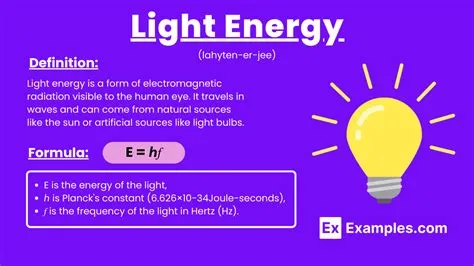
INTERIORDECOR.BIZ.ID – Light is a fundamental concept in physics, often described as a form of electromagnetic radiation that is visible to the human eye. It plays a crucial role in our perception of the world and interacts with matter in fascinating ways. Understanding the definition of light is key to grasping its energetic properties.
At its core, light represents energy traveling through space. This energy is carried by photons, which are massless elementary particles that act as quanta of the electromagnetic field. These photons can be thought of as tiny packets of energy that move at the speed of light.
The Electromagnetic Spectrum
Light exists as part of a broader spectrum known as the electromagnetic spectrum. This spectrum encompasses all types of electromagnetic radiation, from radio waves with long wavelengths to gamma rays with very short wavelengths.
Visible light occupies a small portion of this spectrum, the range of wavelengths that our eyes can detect. Different wavelengths within this visible range are perceived by our brains as different colors, forming the rainbow spectrum we are familiar with.
Light as Waves and Particles
A key aspect of light’s definition is its dual nature: it behaves as both a wave and a particle. This concept, known as wave-particle duality, is a cornerstone of quantum mechanics.
As a wave, light exhibits phenomena like diffraction and interference, which are characteristic of wave behavior. For instance, when light passes through a narrow slit, it spreads out, a demonstration of diffraction.
As a particle, light consists of discrete packets of energy called photons. These photons carry momentum and can interact with matter in ways that are best explained by particle theory, such as the photoelectric effect.
Energy of Light
The energy of light is directly proportional to its frequency and inversely proportional to its wavelength. Higher frequency light, such as blue or violet light, carries more energy than lower frequency light, like red light.
This relationship is quantified by Planck’s equation, E = hf, where E is the energy of a photon, h is Planck’s constant, and f is the frequency of the light. This equation highlights how light is inherently energetic.
Sources of Light Energy
The most prominent source of light energy for our planet is the Sun. Solar energy reaches Earth in the form of electromagnetic radiation, including visible light, infrared radiation (heat), and ultraviolet radiation.
This solar energy is vital for life on Earth. It warms our planet, drives weather patterns, and is the primary energy source for photosynthesis, the process plants use to create food.
Interaction of Light with Matter
When light encounters matter, several interactions can occur, all involving the transfer of energy. These interactions include absorption, reflection, and transmission.
Absorption happens when the energy of a photon is taken up by the atoms or molecules of a substance, often increasing their internal energy. Reflection occurs when light bounces off a surface, redirecting its path and some of its energy.
Transmission is when light passes through a material, potentially with some energy loss or change in direction. The color of an object, for example, is determined by which wavelengths of light it absorbs and which it reflects.
Applications of Light Energy
The energetic nature of light has led to numerous technological advancements and applications. Solar panels convert light energy directly into electrical energy through the photovoltaic effect.
Lasers, which produce a highly concentrated beam of light, are used in everything from barcode scanners and medical surgeries to scientific research and telecommunications, all leveraging the focused energy of light.
Light and Perception
Beyond its physical properties, light is essential for our perception of the world. Our eyes detect light, and our brain interprets these signals as images, allowing us to see shapes, colors, and movement.
Without light, our primary means of visual interaction with our environment would be impossible. The definition of light, therefore, extends to its role as a medium for information transfer about our surroundings.
The Future of Light Energy
Ongoing research continues to explore new ways to harness and utilize light energy. Advances in areas like quantum optics and photonics promise even more innovative applications in the future.
Understanding the fundamental definition of light as energy is crucial for unlocking its full potential and addressing global energy needs sustainably.
Frequently Asked Questions
What is the most basic definition of light?
The most basic definition of light is a form of electromagnetic radiation that makes objects visible to our eyes.
Is light a form of energy?
Yes, light is a form of energy that travels in packets called photons.
What is the relationship between light and energy?
Light is energy that is emitted or reflected by objects. The energy of light is related to its color or wavelength.
What are the two main properties of light?
Light exhibits wave-particle duality, meaning it can behave as both a wave and a particle.
How does light energy affect the Earth?
Sunlight, a form of light energy, warms the Earth, drives weather patterns, and is essential for photosynthesis and life itself.
Written by: Sarah Davis