
 ZeckRV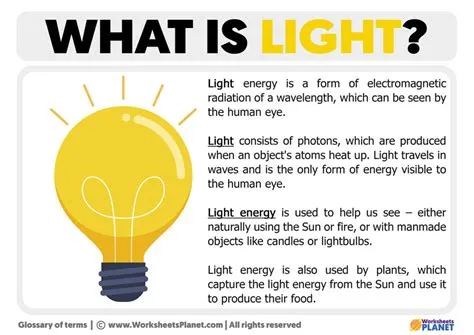
INTERIORDECOR.BIZ.ID – Light is a fascinating and essential part of our world, allowing us to see and interact with everything around us. For many living organisms, light is a primary tool for perceiving their environment and engaging with it. The Sun’s light, for example, warms our planet and drives weather patterns, playing a crucial role in sustaining life.
In simple terms for Class 5 students, light can be defined as a form of energy that travels in waves. These waves are so small that we cannot see them, but they allow us to see colors, shapes, and objects. Think of it like ripples on a pond, but instead of water, it’s energy moving through space.
What is Light?
Light is a type of electromagnetic radiation, which means it’s made up of electric and magnetic fields that travel together. It’s part of a larger spectrum of waves, some of which we can see (like visible light) and some we cannot (like radio waves or X-rays).
Our eyes are specifically designed to detect this visible light. When light bounces off an object and enters our eyes, our brain interprets these signals as images, allowing us to see the world in all its detail.
Sources of Light
There are two main types of light sources: natural and artificial. Natural sources are those that exist without human intervention. The most important natural source of light for Earth is the Sun, which provides warmth and illumination.
Artificial sources of light are created by humans. Examples include light bulbs in our homes, flashlights, and even candles. These sources are designed to produce light for our convenience and needs.
How Light Travels
Light travels in straight lines, a concept known as rectilinear propagation. Imagine shining a flashlight in a dark room; the beam of light moves in a straight path. This is why shadows are formed when an object blocks the path of light.
When light encounters a surface, it can do a few things: it can be reflected, absorbed, or transmitted. Reflection is what happens when light bounces off a surface, like a mirror. Absorption occurs when a surface takes in the light’s energy, often turning it into heat.
Reflection and Absorption
Reflection is how we see many objects. The light from a source hits an object, bounces off its surface, and then travels to our eyes. This is why a red apple looks red – it reflects red light and absorbs other colors.
Absorption is also important. Darker surfaces tend to absorb more light than lighter surfaces. This is why you might feel warmer on a sunny day if you wear a black shirt compared to a white one, as the black shirt absorbs more sunlight.
Light and Color
The colors we see are all due to different wavelengths of visible light. White light, like sunlight, is actually a mixture of all the colors of the rainbow: red, orange, yellow, green, blue, indigo, and violet (ROY G. BIV).
When white light passes through a prism, it splits into its individual colors, demonstrating that white light is composed of all these different colors. Each color has a different wavelength, and our eyes and brain process these differences.
Refraction
Another interesting phenomenon related to light is refraction. Refraction happens when light passes from one medium to another, like from air to water. When this happens, the light bends or changes direction.
A common example of refraction is when a straw placed in a glass of water appears to be bent or broken at the water’s surface. This bending occurs because light travels at different speeds through different materials.
Importance of Light
Light is not just for seeing; it’s fundamental to life on Earth. Plants use sunlight for photosynthesis, the process that allows them to create their own food and produce the oxygen we breathe.
Beyond its biological importance, light also plays a role in our mood and well-being. Sunlight helps regulate our sleep cycles and can boost our spirits. Understanding light helps us appreciate the natural world and the technologies we use every day.
In summary, light is a vital energy that travels in waves, enabling us to see, warming our planet, and fueling life. From its sources to how it interacts with objects, light is a fundamental concept in science.
By understanding these basic principles of light, Class 5 students can begin to grasp its importance and the amazing ways it shapes our world. The next time you see a rainbow or a shadow, remember the science behind it!
Frequently Asked Questions About Light
Q1: What is the fastest thing in the universe?
A1: Light is the fastest thing in the universe, traveling at an incredible speed of about 299,792 kilometers per second in a vacuum.
Q2: Why is the sky blue?
A2: The sky appears blue because of a phenomenon called Rayleigh scattering. Sunlight, which contains all colors, enters the Earth’s atmosphere, and the shorter, bluer wavelengths of light are scattered more by the gas molecules in the air than other colors.
Q3: Can light be a particle?
A3: Yes, light has a dual nature. It can behave both as a wave and as a particle. The particle of light is called a photon.
Q4: What happens when light is absorbed?
A4: When light is absorbed by an object, its energy is converted into other forms of energy, often heat. This is why dark objects get warmer in sunlight.
Q5: How do we see colors?
A5: We see colors because objects reflect certain wavelengths of light while absorbing others. Our eyes detect these reflected wavelengths, and our brain interprets them as different colors.
Written by: David Thomas