
 ZeckRV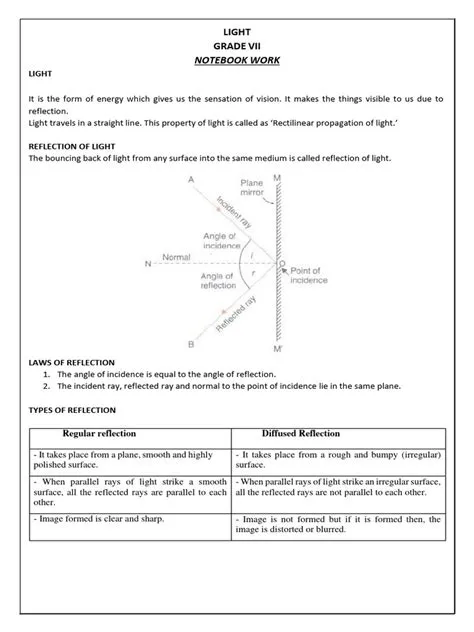
INTERIORDECOR.BIZ.ID – Light is a fundamental concept in physics that plays a crucial role in our daily lives and our understanding of the universe. For many organisms, light is the primary tool for perceiving the world and interacting with it. The Sun’s light warms our planet, influences weather patterns, and is essential for life itself.
In Class 7 physics, we begin to explore the nature of light as a form of energy that allows us to see. It’s this visible energy that travels from objects to our eyes, enabling sight. Without light, the world would remain unseen and mysteries would remain unsolved.
What is Light?
Scientifically, light is a form of electromagnetic radiation. Think of it as waves of energy that travel through space. These waves have properties like wavelength and frequency, which determine the color of the light we see.
These waves can also behave like tiny packets of energy called photons. This dual nature, acting as both a wave and a particle, is one of the fascinating aspects of light studied in physics.
The Electromagnetic Spectrum
Visible light is just a small part of a much larger range of electromagnetic waves known as the electromagnetic spectrum. This spectrum includes radio waves, microwaves, infrared radiation, ultraviolet radiation, X-rays, and gamma rays, all differing in their wavelengths and energies.
Our eyes are specifically tuned to detect the wavelengths that fall within the visible light portion of this spectrum. Other animals, like bees, can see ultraviolet light, which is invisible to us.
Sources of Light
Objects that produce their own light are called luminous sources. The most prominent luminous source in our solar system is the Sun, which emits light through nuclear fusion reactions. Other examples include light bulbs, candles, and stars.
Non-luminous objects, on the other hand, do not produce their own light. Instead, they reflect light from luminous sources. For instance, the Moon is visible because it reflects sunlight, and we see a book because it reflects light from a lamp or the sun.
Properties of Light
One of the most basic properties of light is that it travels in straight lines. This phenomenon is called the rectilinear propagation of light. We can observe this when light shines through a small opening, casting a sharp shadow.
Another key property is the speed of light. Light travels incredibly fast, approximately 300,000 kilometers per second in a vacuum, making it the fastest thing in the universe. This speed is constant under vacuum conditions.
Reflection and Refraction
When light strikes a surface, it can bounce off; this is known as reflection. The angle at which light hits a surface is equal to the angle at which it bounces off, a principle crucial for understanding how mirrors work.
Light can also bend as it passes from one medium to another, like from air to water. This bending is called refraction, and it’s why a straw in a glass of water appears to be broken.
The Importance of Light
Light is indispensable for vision, allowing us to see shapes, colors, and details of the world around us. It’s the basis of sight for humans and many other creatures.
Beyond vision, light from the Sun provides warmth, drives photosynthesis in plants which forms the base of most food chains, and influences climate patterns on Earth.
Light as Energy
Light carries energy, which can be converted into other forms of energy. Solar panels, for example, convert light energy from the sun directly into electrical energy.
This energy transfer is fundamental to many natural processes and technological applications. Understanding light’s energy is key to harnessing it effectively.
Conclusion
In summary, light is a fascinating form of energy that travels as electromagnetic waves and can also behave as particles called photons. It’s essential for sight, influences our planet, and has diverse properties like traveling in straight lines, reflecting, and refracting.
As you continue your physics journey in Class 7 and beyond, exploring the behavior and properties of light will unlock a deeper understanding of the physical world and the universe we inhabit.
Frequently Asked Questions about Light
- What is the primary role of light in physics?
- In physics, light is studied as a fundamental form of energy, specifically electromagnetic radiation, that enables us to perceive the world and understand phenomena like vision, optics, and energy transfer.
- Is light a wave or a particle?
- Light exhibits a dual nature, behaving as both a wave (with properties like wavelength) and a particle (photons). This concept is known as wave-particle duality.
- What are examples of luminous and non-luminous objects?
- Luminous objects produce their own light, like the Sun or a light bulb. Non-luminous objects, such as a book or the Moon, are visible because they reflect light from other sources.
- Why does light bend when it enters water?
- Light bends when it enters a different medium (like water from air) because its speed changes. This bending phenomenon is called refraction.
- How fast does light travel?
- Light travels at an astonishing speed of approximately 300,000 kilometers per second in a vacuum, making it the fastest known entity.
Written by: Emma Johnson