
 ZeckRV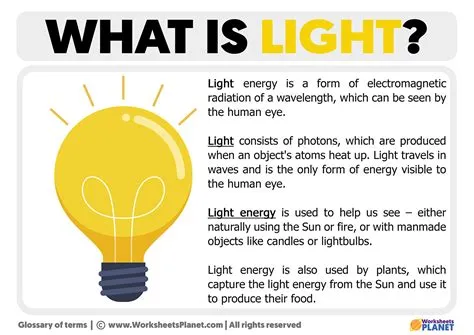
INTERIORDECOR.BIZ.ID – Light is a fundamental aspect of our universe, playing a crucial role in how we perceive and interact with our surroundings. It is a form of electromagnetic radiation that our eyes can detect, enabling us to see the world in all its vibrant detail.
At its core, light is defined as visible electromagnetic radiation. This radiation travels in waves and carries energy, allowing it to illuminate objects and transmit information across vast distances. It’s essentially the messenger that allows our visual system to function.
What is Light?
Light is a portion of the electromagnetic spectrum that is visible to the human eye. This spectrum includes other forms of radiation like radio waves, microwaves, infrared, ultraviolet, X-rays, and gamma rays, which are not visible to us.
The behavior of light can be described by both wave and particle properties. As a wave, it exhibits phenomena like diffraction and interference. As a particle, it is composed of discrete packets of energy called photons.
The Wave Nature of Light
When we talk about light as a wave, we are referring to oscillations of electric and magnetic fields traveling through space. These waves have specific wavelengths and frequencies, which determine their color and energy.
For example, red light has a longer wavelength and lower frequency compared to blue light, which has a shorter wavelength and higher frequency. This difference in wavelengths is what creates the spectrum of colors we see.
The Particle Nature of Light
Alternatively, light can be thought of as a stream of particles called photons. Each photon carries a specific amount of energy, which is directly proportional to the frequency of the light wave.
This dual nature, known as wave-particle duality, is a cornerstone of quantum mechanics and helps explain various optical phenomena. When light interacts with matter, it can behave as either a wave or a particle, depending on the situation.
Examples of Light in Our World
The most significant source of light for Earth is the Sun. Sunlight warms our planet, drives weather patterns, and initiates life-sustaining processes like photosynthesis in plants.
Beyond natural sources, humans have created artificial light sources for various purposes. These include incandescent bulbs, fluorescent lights, and modern LED (Light Emitting Diode) technology, each with its own characteristics and applications.
Natural Light Sources
The Sun is the primary source of natural light, providing the energy that sustains almost all life on Earth. Its light allows plants to produce food and keeps our planet at a habitable temperature.
Other natural light sources include stars, lightning, and bioluminescent organisms like fireflies and certain deep-sea creatures, demonstrating light’s diverse manifestations in nature.
Artificial Light Sources
Humans have developed numerous ways to generate artificial light for illumination and other functions. These technologies have revolutionized daily life, allowing us to extend our activities beyond daylight hours.
Examples include the electric light bulb, which converts electrical energy into light and heat, and lasers, which produce a highly focused beam of light for precise applications.
The Importance of Light
Light is indispensable for vision, allowing us to navigate our environment, recognize objects, and communicate through facial expressions and gestures. Without light, the world would be shrouded in darkness, and our ability to perceive it would be lost.
Furthermore, light plays a vital role in biological processes. It is essential for vitamin D synthesis in humans and is the energy source for photosynthesis, the process by which plants convert carbon dioxide and water into oxygen and glucose.
Light and Vision
Our eyes are specifically designed to detect light. When light enters the eye, it strikes the retina, where specialized cells called photoreceptors convert the light signals into electrical impulses that are sent to the brain for interpretation.
The quality and intensity of light significantly impact our visual experience, affecting everything from our ability to read fine print to our perception of color and depth.
Light and Life Processes
The Sun’s light is the ultimate energy source for most ecosystems. Plants use light energy to perform photosynthesis, creating the food that forms the base of most food chains.
Light also influences circadian rhythms, the natural sleep-wake cycles in humans and many other animals, helping to regulate various physiological processes and behaviors.
Frequently Asked Questions (FAQ)
What is the basic definition of light?
Light is defined as visible electromagnetic radiation, which travels in waves and carries energy, allowing us to see the world.
Can you give an example of natural light?
The Sun is the most significant natural source of light, providing warmth and energy essential for life on Earth.
What are some examples of artificial light?
Examples of artificial light include incandescent bulbs, fluorescent lights, and LED technology used for illumination.
Why is light important for life?
Light is crucial for vision, enabling us to perceive our surroundings, and it is the energy source for photosynthesis, which produces oxygen and food.
Does light have both wave and particle properties?
Yes, light exhibits wave-particle duality, meaning it can behave as both a wave and a stream of particles called photons, depending on the phenomenon observed.
Written by: Olivia Anderson