
 ZeckRV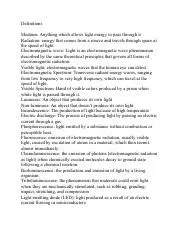
INTERIORDECOR.BIZ.ID – Light is a fundamental phenomenon that allows us to perceive and interact with the world around us. Understanding its various definitions and properties is crucial for grasping many scientific concepts.
From a physics perspective, light is a form of electromagnetic radiation, a stream of photons traveling in waves. These waves possess both electric and magnetic field components oscillating perpendicularly to each other and to the direction of propagation.
What is Light?
At its core, light can be defined as electromagnetic radiation within the portion of the electromagnetic spectrum that is visible to the human eye. This visible spectrum typically ranges from approximately 400 to 700 nanometers in wavelength.
It’s important to note that the electromagnetic spectrum is vast, encompassing radio waves, microwaves, infrared, ultraviolet, X-rays, and gamma rays, all of which are forms of light but not visible to us.
The Dual Nature of Light
One of the most fascinating aspects of light is its dual nature, exhibiting characteristics of both waves and particles. This wave-particle duality is a cornerstone of quantum mechanics.
As a wave, light demonstrates phenomena like diffraction (bending around obstacles) and interference (when waves combine). As a particle, it behaves as discrete packets of energy called photons, which can transfer energy and momentum.
Key Properties of Light
Light travels at an incredibly high speed, approximately 299,792 kilometers per second in a vacuum. This constant speed, denoted by ‘c’, is a fundamental constant in physics.
When light passes from one medium to another, such as from air to water, its speed changes, causing it to bend. This phenomenon is known as refraction.
Color and Wavelength
The color of light is determined by its wavelength. Different wavelengths within the visible spectrum correspond to different colors, from red (longer wavelengths) to violet (shorter wavelengths).
White light, like that from the sun, is not a single color but a composite of all the colors in the visible spectrum. When white light passes through a prism, it can be separated into its constituent colors, creating a rainbow effect.
The Importance of Light
Light from the Sun is indispensable for life on Earth, providing warmth and energy. Photosynthesis, the process by which plants convert light energy into chemical energy, is the foundation of most food chains.
Beyond biological processes, light is a critical tool for human perception and technology. Our vision relies entirely on light reflecting off objects and entering our eyes.
Applications of Light
From the simple act of illumination to advanced technologies, light plays a vital role in our daily lives. Lasers, fiber optics, and digital imaging all depend on the controlled manipulation of light.
Understanding light definitions helps us appreciate its complex nature and its profound impact on everything from the vastness of the cosmos to the intricate workings of our own bodies.
Frequently Asked Questions (FAQ)
What is the primary definition of light in physics?
In physics, light is defined as electromagnetic radiation consisting of photons that travel in waves, possessing oscillating electric and magnetic fields.
What is the visible spectrum of light?
The visible spectrum of light ranges from approximately 400 to 700 nanometers in wavelength and corresponds to the colors we can perceive with our eyes.
Does light behave as a wave or a particle?
Light exhibits a dual nature, behaving as both a wave (demonstrating diffraction and interference) and a particle (photons) in different contexts.
What is the speed of light?
Light travels at approximately 299,792 kilometers per second in a vacuum, a fundamental constant known as ‘c’.
How is the color of light determined?
The color of light is determined by its wavelength; different wavelengths correspond to different colors in the visible spectrum.
Why is sunlight important for life on Earth?
Sunlight is crucial for life as it provides warmth, energy, and drives photosynthesis, the process by which plants create food.
What is refraction?
Refraction is the bending of light as it passes from one medium to another, caused by a change in its speed.
Written by: Sophia Martinez