
 ZeckRV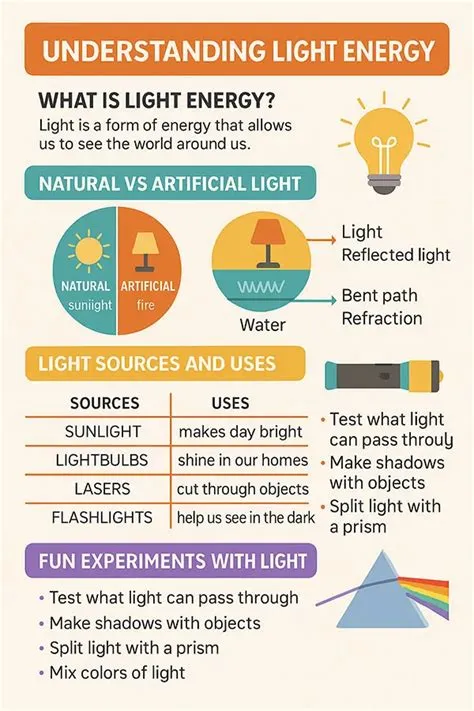
INTERIORDECOR.BIZ.ID – Light energy is a fundamental concept in science, crucial for understanding how we perceive the world and how many natural processes occur. For Class 7 students, grasping the definition of light energy is the first step towards exploring optics and the broader electromagnetic spectrum.
Light, in essence, is a form of energy that allows us to see. It travels in waves and can also behave like particles, a concept known as wave-particle duality. This dual nature makes light a fascinating subject to study in physics.
What is Light Energy?
Light energy is the radiant energy emitted by a light source. This energy travels through space in the form of electromagnetic waves, and it is this energy that stimulates our eyes, enabling vision. Without light energy, the world would appear dark and our ability to interact with our surroundings would be severely limited.
Think of a light bulb; when it’s on, it’s emitting light energy. This energy then travels outwards in all directions, illuminating the room. This is a practical example of light energy in action, making it a primary tool for perceiving and interacting with our environment.
The Sun: Our Primary Source of Light Energy
The most significant source of light energy for Earth is the Sun. The Sun’s radiant energy not only provides light but also warmth, playing a vital role in maintaining habitable temperatures on our planet. This solar energy drives global weather patterns and initiates crucial life-sustaining processes.
Photosynthesis, the process by which plants create their own food, directly relies on light energy from the Sun. This highlights how essential light energy is for the existence and continuation of life on Earth, from the smallest organism to entire ecosystems.
Properties of Light Energy
Light energy exhibits several key properties that are important to understand. It travels at an incredibly high speed, approximately 299,792 kilometers per second in a vacuum, making it the fastest thing in the universe.
Another property is its ability to travel in straight lines, which is why we can observe shadows. When an object blocks the path of light, an area of darkness forms behind it, demonstrating the linear propagation of light energy.
Interaction with Matter
When light energy encounters matter, it can be reflected, refracted, absorbed, or transmitted. Reflection is when light bounces off a surface, like a mirror. Refraction is when light bends as it passes from one medium to another, such as from air to water.
Absorption occurs when the energy of light is taken in by the material, often converting into heat. Transmission is when light passes through the material, like light passing through a clear glass window. These interactions explain how we see objects and why some objects are transparent, translucent, or opaque.
Visible Light Spectrum
The light energy we can see is part of a larger spectrum of electromagnetic radiation. This visible spectrum is what our eyes detect, and it is composed of different colors: red, orange, yellow, green, blue, indigo, and violet (ROYGBIV).
Each color corresponds to a different wavelength and frequency of light energy. When all these colors are combined, we perceive white light. When light is split, for example, by a prism, we can see the individual colors that make up white light.
Applications of Light Energy
Light energy has numerous applications in our daily lives and in technology. From simple tasks like illumination to complex scientific instruments, its utility is vast. Lasers, for example, are devices that produce a highly concentrated beam of light energy for various uses.
In medicine, light energy is used in therapies like phototherapy and laser surgery. In communication, fiber optics use light pulses to transmit data at high speeds, demonstrating the versatility and power of light energy.
Key Takeaways
- Light energy is radiant energy that enables us to see and interact with our environment.
- The Sun is the primary source of light energy for Earth, driving weather and supporting life.
- Light travels extremely fast and in straight lines.
- Light interacts with matter through reflection, refraction, absorption, and transmission.
- The visible spectrum consists of different colors, each with a unique wavelength.
- Light energy has diverse applications in technology, medicine, and communication.
Understanding light energy is not just about knowing its definition; it’s about appreciating its role in the universe. From powering life on Earth to enabling advanced technologies, light energy is a fundamental force.
As you continue your science education, explore how light interacts with different materials and phenomena. This knowledge will deepen your understanding of the physical world around you.
Frequently Asked Questions about Light Energy
What is the definition of light energy for Class 7?
Light energy is a form of energy that travels as waves and allows us to see. It is emitted by light sources like the Sun or a lamp.
Where does most of our light energy come from?
Most of the light energy that reaches Earth comes from the Sun.
Can light energy be converted into other forms of energy?
Yes, light energy can be converted into other forms, such as heat energy when absorbed by an object, or chemical energy during photosynthesis in plants.
What happens when light hits a mirror?
When light hits a mirror, it is reflected, meaning it bounces off the surface, which is how mirrors allow us to see images.
Is light a wave or a particle?
Light has a dual nature, behaving as both a wave and a particle, a concept known as wave-particle duality.
Written by: Sarah Davis