
 ZeckRV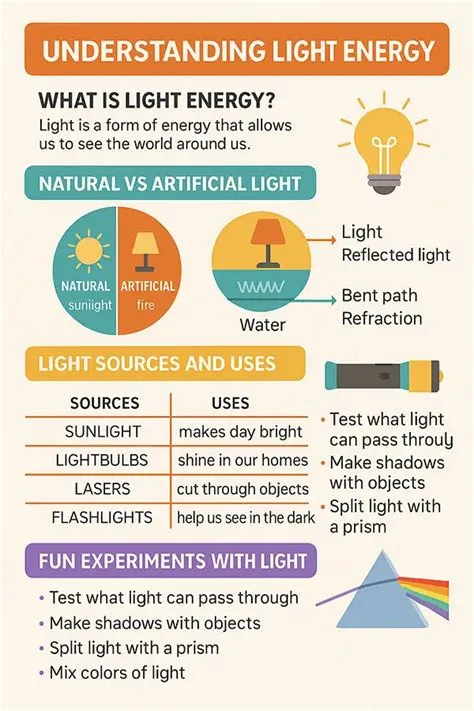
INTERIORDECOR.BIZ.ID – Light energy is fascinating and all around us, playing a crucial role in our daily lives and the world we inhabit. It is the energy that allows us to see, feel warmth, and keeps our planet alive. For many organisms, light is the primary tool for perceiving their surroundings and interacting with them.
The Sun, a giant star, is our most significant source of light energy. This radiant energy travels vast distances to reach Earth, warming our planet and powering essential natural processes. Without the Sun’s light, life as we know it would not exist.
What is Light Energy?
In simple terms, light energy is a form of energy that travels in waves and can be seen by our eyes. Think of it like tiny, invisible waves carrying packets of energy through space. This energy allows us to see colors, shapes, and everything around us.
These waves have different properties, such as wavelength and frequency, which determine the type of light we perceive. For example, the light that allows us to see is called visible light, but there are other types of light we cannot see, like infrared and ultraviolet.
Visible Light Explained
Visible light is the part of the electromagnetic spectrum that human eyes can detect. When white light from the Sun or a lamp passes through a prism, it splits into a rainbow of colors: red, orange, yellow, green, blue, indigo, and violet. Each color has a different wavelength, which is why they separate.
This spectrum is how we differentiate objects and their colors. The surface of an object absorbs some wavelengths of light and reflects others; the reflected wavelengths are what we perceive as the object’s color. For instance, a red apple absorbs most colors but reflects red light.
The Sun: Our Primary Light Source
The Sun is a massive ball of hot gas that continuously produces light and heat energy through a process called nuclear fusion. This energy radiates outwards in all directions, traveling at an incredible speed.
This solar energy is vital for Earth’s climate and weather patterns. It warms the oceans and land, drives wind, and powers the water cycle, making our planet a habitable place.
How We Use Light Energy
Our ability to see is entirely dependent on light energy. When light bounces off an object and enters our eyes, it stimulates special cells in our retinas. These cells send signals to our brain, which interprets them as images.
Beyond vision, light energy has many other applications. We use it for illumination in our homes and cities, allowing us to function even when the sun isn’t shining. This artificial light often comes from bulbs that convert electrical energy into light.
Light and Plants
Plants use light energy from the Sun to make their own food through a process called photosynthesis. This is how they grow and produce the oxygen we breathe. Think of leaves as tiny solar panels that capture sunlight.
During photosynthesis, plants take in carbon dioxide from the air and water from the soil, and using the Sun’s light energy, they convert these into sugars (food) and oxygen. This fundamental process supports almost all life on Earth.
Other Forms of Light Energy
While we commonly think of visible light, the electromagnetic spectrum includes many other forms of light energy. These range from radio waves with long wavelengths to gamma rays with very short wavelengths.
Examples include infrared radiation, which we feel as heat, and ultraviolet (UV) radiation from the Sun, which can cause sunburn but is also used by our bodies to produce Vitamin D. Microwaves and X-rays are also parts of this energy spectrum.
The Importance of Light
Light energy is fundamental to life on Earth, enabling vision, driving weather, and fueling plant growth. Its influence extends from the microscopic world of photosynthesis to the grand scale of our planet’s climate.
Understanding light energy helps us appreciate the complex and interconnected systems that make our world function. It’s a powerful force that shapes our environment and allows us to explore and interact with it every day.
FAQ Section
Frequently Asked Questions About Light Energy
-
What is light energy in simple terms?
Light energy is the energy that allows us to see and that travels in waves, like ripples on water, carrying packets of energy through space.
-
Where does most of our light energy come from?
The Sun is our biggest source of light energy, providing warmth and the power for many natural processes on Earth.
-
Why do we see different colors?
We see different colors because objects absorb some light waves and reflect others; the reflected waves are what our eyes detect as color.
-
How do plants use light energy?
Plants use light energy through photosynthesis to make their own food, similar to how they use tiny solar panels in their leaves.
-
Are there other types of light energy we can’t see?
Yes, there are other types like infrared (heat) and ultraviolet (UV) rays, which are part of the same energy spectrum but invisible to our eyes.
Written by: Robert Miller